
The Canadian B2B landscape is currently suffering from a structural defect that most CEOs mistake for a “market slowdown” or a “sales talent issue.” It is neither. The inconsistency in your pipeline is a direct result of a mechanical failure in how revenue systems are designed and executed within the Canadian cultural context.
We call this the Consensus Crisis.
In Canada, the path to a closed-won deal is rarely a straight line. It is a labyrinth of stakeholders, risk-aversion, and a cultural mandate for total agreement before a single dollar is committed. While US-based sales organizations often operate on a high-velocity, individual-authority model, Canadian B2B buying cycles are defined by a collective “not-yet.”
If your pipeline feels like a roller coaster, you aren’t looking for a “better salesperson.” You are looking for a Revenue Architect to repair a broken system.
The Diagnosis: Land, Expand, and the Structural Failure of “Nice”
To understand why your revenue engine is stalling, we must look at the mechanics of the Canadian sale. Revenue is not a series of heroics; it is a machine. When that machine is forced to process Canadian consensus-driven buying patterns without a standardized framework, the gears grind to a halt.
1. The Land Phase: Cultural Friction and the Consensus Loop
In the “Land” phase of Revenue Engineering, the goal is to establish a foothold within a target account. In the US, this often involves finding a single “champion” with the budget and authority to pull the trigger. In Canada, that champion rarely exists in isolation.
The Canadian B2B environment requires a broader consensus. You are not selling to a person; you are selling to a committee that is culturally predisposed to avoid the risk of a unilateral decision. This creates a “Consensus Loop” where deals enter the pipeline, show initial promise, and then vanish into a black hole of internal meetings and “checking in with the team.”
Without Sales Process Standardization, your reps are left guessing which stakeholder actually holds the veto power. They treat every deal as a unique event rather than a repeatable mechanical process. This lack of standardization is the primary cause of pipeline volatility.
2. The Expand Phase: The Absence of Sales Rigor
Most Canadian B2B companies lack a formal sales framework. They rely on “relationship building”: a tactic that is unscalable and impossible to measure. When we audit these organizations, we find a total absence of diagnostic rigor.
At Atlantic Growth Solutions, we utilize the Sandler Atlantic framework to counteract this. Specifically, we look at the BAT Triangle (Behavior, Attitude, Technique).
- Behavior: Are your reps executing the daily “gutsy” activities required to feed the engine?
- Attitude: Do they view themselves as peers to the prospect, or as subservient “vendors” begging for time?
- Technique: Are they using Up-Front Contracts to ensure every meeting has a clear, binary outcome?
When these elements are missing, the “Expand” phase fails. You cannot expand your footprint in a market if your sales team is stuck in a cycle of “hope-based selling.”
The Cost of the “Hero” Culture
The most dangerous defect in a Canadian B2B firm is the Sales Hero. You know the one: the top performer who “just has a feeling” about a deal.
Heroics are the enemy of consistency. If your revenue depends on the individual brilliance of a single rep, you don’t have a business; you have a high-stakes gamble. Revenue Engineering replaces the hero with a system.
When you treat revenue as an engineering discipline, you stop asking “How did the call go?” and start asking “What is the status of the Up-Front Contract?” You move from subjective optimism to objective data. This is the role of the Revenue System Operator.
Structural Defects: US vs. Canada Pipeline Dynamics
The lack of Pipeline Consistency in Canada is often exacerbated by trying to copy-paste US sales tactics into a Canadian environment without adjusting for the consensus requirements.
| Feature | US Sales Model (High Velocity) | Canadian Sales Model (Consensus Driven) |
|---|---|---|
| Decision Authority | Often centralized (The “Economic Buyer”) | Distributed (The Committee) |
| Sales Cycle | Shorter, aggressive | Longer, deliberate |
| Risk Tolerance | High (Fail fast) | Low (Avoid embarrassment) |
| Process Need | High | Critical |
Because Canadian buying cycles are longer, any gap in your Precision Pipeline Generation becomes a cavernous hole three months down the line. If your “Revenue Engineering” isn’t consistently feeding the top of the funnel with qualified opportunities, the “Consensus Crisis” will ensure your quarterly targets are missed before the quarter even begins.

The Solution: Consolidate the Revenue System
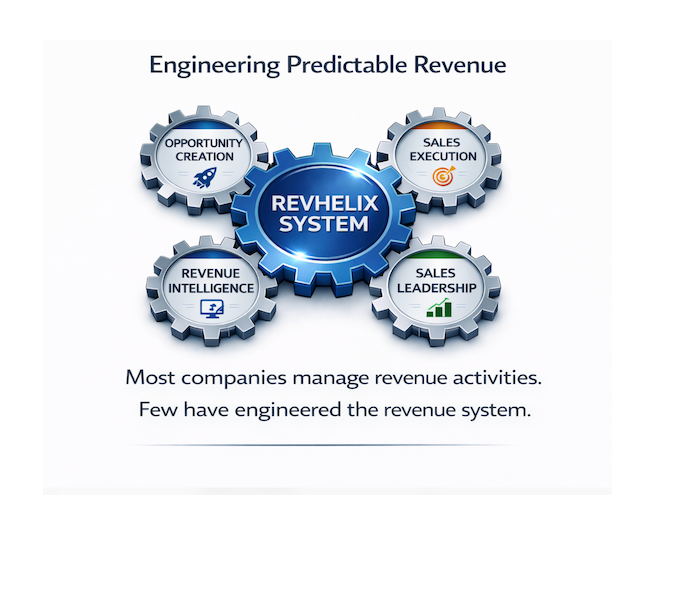
To fix a broken pipeline, you must consolidate your efforts into a single, cohesive engine. This is what we call The Revenue System Assessment. It is not a “service”; it is a Revenue System. For a deeper breakdown of how to build that machine, read The Ultimate Guide to Revenue Systems.
Precision Pipeline Generation
In a consensus-driven market, you cannot wait for the phone to ring. You need a system that identifies the entire stakeholder group and initiates the conversation before the “Consensus Loop” can stagnate. This requires Precision Pipeline Generation that utilizes tech-enabled human expertise.
We don’t believe in “lead generation” as a standalone activity. We believe in embedding AI-driven lead generation and appointment setting directly into the Revenue System Operator model. This ensures that the inputs (qualified leads) are perfectly calibrated for the outputs (closed revenue).
The Sandler Atlantic Edge
Standardization requires a common language. By applying Sandler Sales Training principles, Canadian firms can overcome the “nice” factor that kills deals.
- Negative Reverses: Instead of pushing a prospect who is being vague, a trained rep will pull back. “It sounds like this isn’t a priority for your team right now. Should we just close the file?” This forces the consensus group to make a decision or get out of the way.
- Up-Front Contracts: Every interaction must end with a clear “Yes” or “No” regarding the next step. “Maybe” is a structural failure.
The Revenue Architect’s Inspection
If you are experiencing a lack of consistency, run this diagnostic on your current sales machine:
- Do you have a written, standardized sales process that every rep follows without exception? If not, your pipeline is a series of accidents.
- Does your team use Up-Front Contracts in every meeting? If not, your “qualified” leads are likely just polite conversations.
- Is your pipeline generation automated and systematic, or does it rely on rep “prospecting” when they have free time? If it’s the latter, your engine is running out of fuel.
- Are you managing activities or outcomes? A machine is managed by its inputs and throughput. If you only look at the “Close” at the end of the month, you are managing by looking in the rearview mirror.
Moving Toward Predictability
Consistency is a byproduct of engineering, not luck. Canadian B2B companies that survive the next decade will be the ones that stop treating sales as a “soft skill” and start treating it as a revenue system.
The “Consensus Crisis” isn’t going away. Canadian buyers will continue to be cautious, deliberate, and committee-based. The question is whether your sales organization has the structural integrity to navigate that complexity or if it will continue to buckle under the weight of an inconsistent pipeline.
Stop looking for heroes. Start building a system.
If your revenue engine is showing signs of mechanical failure, it’s time for a professional audit. Explore how the Revenue System Assessment can stabilize your pipeline through precision engineering and standardized sales rigor.

Atlantic Growth Solutions provides the Revenue Architecture and human expertise required to turn volatile sales efforts into a predictable revenue machine. We don’t just find leads; we engineer the entire path from first contact to signed contract.
Don’t let the Consensus Crisis dictate your growth. Fix the system.