
Pipeline failure is never an accident. It is the predictable outcome of a structural defect in your revenue system.
When a B2B organization experiences a “bad month” or a “dry spell,” leadership typically defaults to one of three reactive behaviors: they demand more activity from the sales team, they buy another piece of martech, or they hire a “hero” sales rep to save the day. None of these actions address the root cause. If your pipeline is inconsistent, the machine is broken. Pushing a broken machine harder only accelerates its eventual collapse.
In the world of Revenue Engineering, we do not look for excuses. We look for constraints. If your revenue isn’t predictable, your system isn’t working.
Land: The Diagnosis of Structural Failure
To fix a system, you must first acknowledge that it is a system. Most B2B companies operate as a loose collection of departments: Marketing, Sales, and Operations: each running their own playbooks with varying degrees of alignment. This is not a system; it is a pile of parts.
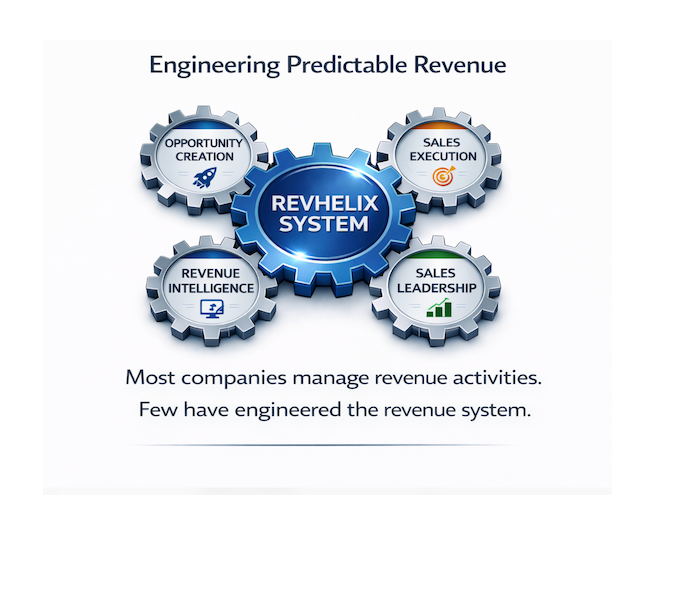
A high-functioning revenue system is a closed-loop circuit consisting of four critical gears: Opportunity Creation (Pipeline), Sales Execution (Conversion), Sales Leadership, and Revenue Intelligence (Forecasting).
When pipeline “breaks,” it usually manifests as one of the following structural defects:
1. Harmonic Resonance of Activity (The “Rollercoaster” Effect)
This occurs when the team focuses exclusively on closing deals at the end of a quarter, causing them to neglect Precision Pipeline Generation. The result is a surge in revenue followed by a massive “air pocket” where no new opportunities exist. This is a design flaw in time allocation and process discipline.
2. Material Impurity (Low-Quality “Leads”)
If your top-of-funnel is filled with companies that do not fit your Ideal Customer Profile (ICP), the system is clogged with waste. This waste consumes your most expensive resource: sales rep time. A system that cannot distinguish between a “hand-raiser” and a “qualified opportunity” is a system destined for inefficiency.
3. Structural Fatigue (The Stalled Deal)
Pipeline doesn’t always break because nothing is coming in; it breaks because nothing is moving out. When deals stall for 180 days in “Discovery” or “Proposal Sent,” it indicates a failure in Sales Execution. The “valve” is stuck, and new pressure at the top will not force anything through the bottom.
Expand: Identifying the Primary Constraint
In structural engineering, a bridge is only as strong as its weakest joint. Revenue systems follow the same law. If your Opportunity Creation is a 5/5 but your Sales Execution is a 2/5, your total system performance is a 2. You do not have a lead generation problem; you have a conversion constraint.
To fix the pipeline, you must identify where the flow is restricted. At Atlantic Growth Solutions, we utilize the RevHelix Diagnostic to isolate these variables. We stop guessing and start measuring the mechanical integrity of the commercial engine.
Precision Pipeline Generation: The Feed System
Most companies treat “Lead Gen” as a volume game. They blast thousands of emails and hope for a 1% response rate. This is not engineering; it is gambling.
Precision Pipeline Generation requires a clinical approach to the ICP. Within the RevHelix framework, AI-enabled tools and human expertise are used to identify high-probability targets before the first touchpoint is ever made. We treat the market as a finite set of data points, not an infinite pool of “potential.” If the “Feed System” is not delivering qualified material, the rest of the machine is irrelevant.

Sales Execution: The Conversion Valve
Once the material is in the system, it must be processed. This is where many systems fail due to “Sales Heroics”: reps relying on personality rather than process.
We implement Sandler Sales Training principles to install a disciplined, repeatable methodology. Engineering a sale requires an Up-Front Contract (establishing clear expectations for every interaction) and the use of Negative Reverses (challenging the prospect to ensure the pain is real). If your reps are “chasing” prospects, they aren’t executing a process; they are participating in a structural failure.

A broken pipeline is often just a pipeline full of “maybes.” Sandler-trained teams use a rigorous qualification process to disqualify the “maybes” quickly, clearing the system for high-probability wins. This improves win rates not by magic, but by removing the friction of pursuit for deals that were never going to close.
Consolidate: Maintaining System Integrity
Identifying and fixing a constraint is not a one-time event. Systems decay. Entropy is the natural state of a sales organization. To maintain 100/100 performance, the system requires ongoing Revenue Intelligence and Sales Leadership.
Revenue Intelligence: The Telemetry
If you cannot see the data, you cannot manage the system. We leverage HubSpot Consulting to turn the CRM from a digital filing cabinet into a real-time telemetry suite.
A functional system provides:
- Leading Indicators: Are we creating enough qualified pipeline today to hit the target in six months?
- Conversion Velocity: How fast is a deal moving from “Discovery” to “Contract”?
- Constraint Alerts: Where are deals stalling, and which rep is struggling with specific stages of the Sandler process?
Without this visibility, leadership is flying blind, making “gut-feel” decisions that often exacerbate the very problems they are trying to solve.
Sales Leadership: The System Operator
The final gear is Leadership. The role of a Sales Manager is not to be a “Super-Rep” who closes deals for the team. The role of a manager is to be a system operator.
This involves:
- Evidence-Based Inspection: Moving away from “How do you feel about this deal?” to “Show me the evidence that the prospect has a budget and a documented decision process.”
- Coaching to the Constraint: If a rep has plenty of pipeline but zero closes, the manager must intervene at the Sales Execution level, not the Opportunity Creation level.
- Accountability to the System: Ensuring that the Sandler methodology and CRM requirements are non-negotiable standards of performance.

The Cost of Inaction: Structural Collapse
When you ignore a system constraint, the costs are quantifiable.
- Wasted Capital: Spending $10k/month on “Lead Gen” when your win rate is 10% is a 90% waste of capital.
- Opportunity Cost: Every hour a rep spends on an unqualified deal is an hour they aren’t spending on a high-value target.
- Talent Attrition: Top-tier sales talent will not stay in a broken system. They want to work in an engineered environment where their effort leads to predictable results.
If your revenue has plateaued or become volatile, you do not need more “hustle.” You need a diagnostic report. You need to know which gear is slipping, which valve is leaking, and where the pressure is dropping.
Stop Managing Activities. Start Engineering Revenue.
The era of “hope as a strategy” is over. In a complex B2B environment, the only way to achieve scale is through the intentional design and implementation of a Revenue System.
At Atlantic Growth Solutions, we don’t offer “advice.” We install the infrastructure required for growth. We help you move from a state of “unstable performance” to a “scale-ready” architecture.
The first step is identifying your primary constraint. Until you know what is actually breaking your pipeline, every dollar you spend is a shot in the dark.
Are you ready to see the schematic of your own failure: and how to fix it?