
If revenue isn’t predictable, your system is constrained.
Growth is not limited by effort: it is limited by the part of your system that cannot keep up.
Most B2B companies attempt to solve growth plateaus through the lens of heroics. They demand more activity from their sales teams. They increase spending on outbound efforts. They purchase more tools. They hire more reps.
Yet, the output remains stagnant. Pipeline might increase on paper, but revenue does not follow. Deals progress through stages but never reach a signature. Forecasts are updated weekly but remain consistently inaccurate.
The instinct is to push harder. But in a mechanical system, pushing a jammed gear harder only results in a broken machine. Revenue is not an activity problem. It is not a motivation problem.
? It is a structural constraint within your system design.
What Is a Revenue Constraint?
A revenue constraint is the single factor in your commercial system that limits total output. According to the laws of system dynamics, every complex process has one specific bottleneck that dictates the maximum speed of the entire operation.
No matter how much you optimize the surrounding components, your total growth cannot exceed the capacity of that primary constraint. If your production line is capped at 100 units because of a specific valve, upgrading the rest of the factory to handle 1,000 units is a waste of capital. You still get 100 units. You have simply made the inefficiency more expensive to maintain.
This is not a theoretical concept; it is a fundamental law of engineering applied to business growth.
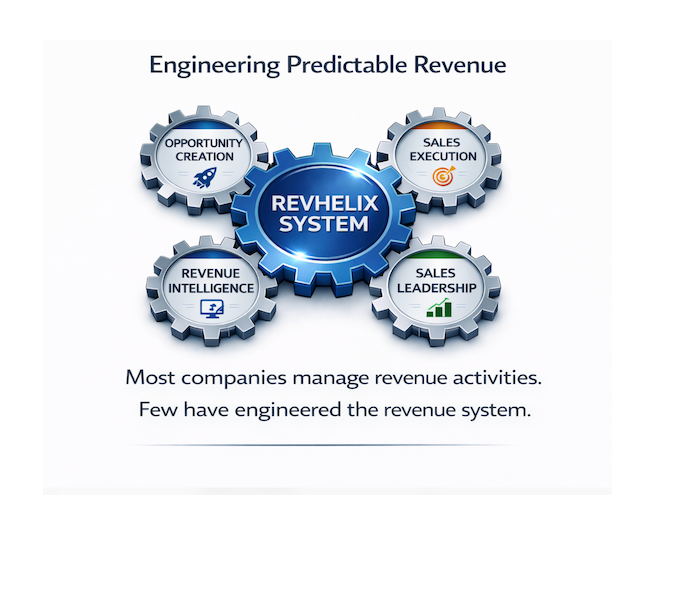
Revenue Works Like a System
Revenue is not a collection of independent activities. It is a linear system that transforms market opportunity into realized cash. To fix a broken system, you must view it as a production line consisting of four core mechanical components:
- Pipeline (Opportunity Creation): The raw input. This is the stage of Precision Pipeline Generation where potential matches are identified and engaged.
- Conversion (Sales Execution): The processing stage. This is where opportunities are qualified and advanced using rigorous frameworks like Sandler Atlantic.
- Leadership (Management and Accountability): The control system. This ensures the gears are turning at the correct RPM and that behaviors align with the intended design.
- Forecast (Data and Visibility): The output sensors. This provides the telemetry required to see where the system is performing and where it is failing.
When one of these components breaks or reaches its limit, the entire system slows down to match the speed of the failure.
Why Most Sales Improvements Fail
Most B2B organizations react to symptoms rather than diagnosing the structural cause. They see a dip in numbers and immediately apply a “best practice” fix:
- Low pipeline? Generate more volume. This often floods the system with low-quality noise, further choking the sales team.
- Low win rates? Train the team on closing techniques. If the leads are unqualified to begin with, no amount of technique will close them.
- Missed forecasts? Build more dashboards. Better reporting on a broken system only allows you to see the failure in higher resolution.
These actions are logical in isolation, but they fail because they ignore the constraint. Improving a part of the system that is not the bottleneck yields zero ROI. In fact, it often decreases performance by adding unnecessary complexity and overhead to a system that is already struggling.

The Core Principle
Improving a non-constraint produces no meaningful system improvement.
When you optimize a high-performing part of the machine while the bottleneck remains untouched, you create “piles of inventory” (stalled deals, unworked leads, or frustrated reps). This creates more activity, more cost, and more management complexity: but zero additional revenue.
Engineering a predictable revenue engine requires the discipline to ignore the noise and focus exclusively on the constraint.
Revenue Is Constrained by System Design
In any given quarter, your organization’s revenue is being throttled by a specific mechanical failure.
PIPELINE | CONVERSION | [ CONSTRAINT ] | LEADERSHIP | FORECAST
Until that middle block is addressed, the flow of revenue will not increase. You cannot “work your way” around a structural defect. You must engineer your way through it.
Where Revenue Constraints Typically Exist
In our diagnostic work at Atlantic Growth Solutions, we find that constraints almost always reside in one of four specific functional areas:
1. Pipeline Constraint
If the constraint is in the pipeline, your system lacks sufficient input. Opportunity flow is inconsistent, coverage is too low to meet targets, and growth stalls before it even starts. The solution is not “more leads,” but rather Precision Pipeline Generation: identifying the exact Ideal Customer Profile (ICP) and engaging them through a structured, tech-enabled system.
? Improve your pipeline engineering
2. Conversion Constraint
If conversion is the constraint, your machine is receiving input but failing to process it. Deals stall in the mid-funnel, win rates decline, and the pipeline becomes an “expensive graveyard.” This is often a failure of sales methodology. Implementing Sandler Sales Training principles: such as Up-Front Contracts and the BAT Triangle (Behavior, Attitude, Technique): removes the friction from sales execution.
3. Leadership Constraint
If leadership is the constraint, the system lacks accountability. Execution is inconsistent across the team, and performance varies wildly between top and bottom performers. Without strong Sales Leadership, even the best-engineered processes will eventually decay.
? Audit your sales leadership structure
4. Forecast Constraint
If forecasting is the constraint, you are flying blind. Your CRM data is unreliable, pipeline reports are inflated, and decisions are made based on gut feeling rather than clinical data. This is a Revenue Operations failure that prevents the system from being steered accurately.

Why Identifying the Constraint Matters
Most organizations guess. They follow the “Squeaky Wheel” method of management: fixing whatever problem is currently making the most noise.
This is an expensive way to run a business. Guessing results in:
- Wasted Capital: Investing in tools or people that the system cannot support.
- Lost Time: Months or years spent on “initiatives” that don’t move the needle.
- Rep Burnout: High-performing sales professionals leaving because they are trapped in a broken machine.
A surgical diagnosis is required to identify the constraint before any capital is deployed for “improvement.”
The System Approach to Growth
Revenue Engineering follows a rigorous five-step loop to ensure continuous, predictable growth:
- Identify the Constraint: Use clinical data to find the one area limiting the entire system.
- Maximize Performance: Ensure the current constraint is working at 100% capacity before adding more resources.
- Align the System: Adjust all other activities to support the constraint (don’t over-feed it or under-supply it).
- Expand Capacity: Invest in technology or talent only when the existing system is fully optimized.
- Repeat: Once the constraint is broken, a new one will inevitably appear elsewhere. Locate it and begin again.

The Cost of Ignoring the Constraint
Ignoring a structural constraint is not a neutral act; it is a compounding expense. The cost of a broken revenue system includes:
- Wasted Outbound Spend: Paying for Precision Pipeline Generation that the sales team cannot effectively convert.
- Stalled Opportunities: The opportunity cost of deals that “should have closed” but died due to poor process.
- Unreliable Forecasts: The inability to make strategic investments because you don’t know what revenue will look like in 90 days.
Growth does not just slow down when a constraint is ignored: it becomes erratic. Heroics might win a deal today, but only a system can win a market.
Related Topics for Revenue Architects
To understand how specific constraints impact your performance, explore our deep-dive diagnostic reports:
If Revenue Isn’t Predictable, the System Isn’t Working
Most companies try to grow by doing more: more outreach, more tools, more pressure. But growth is not a function of effort. It is a function of system design.
In the modern B2B landscape, the “heroic sales rep” is a myth that masks structural defects. Predictable revenue is engineered, not wished for. Until you identify the specific constraint limiting your current output, every other dollar you spend on “growth” is a gamble.
Get Your Revenue System Assessed
If you don’t know where your system is constrained, you are managing by guesswork. Stop optimizing the parts of your business that aren’t the problem. Identify the structural defect limiting your pipeline, conversion, and revenue performance with a clinical Revenue System Assessment.