
Outbound isn’t working the way it used to.
More emails. More calls. More sequences.
Less response. Lower conversion. Declining pipeline quality.
So companies respond the only way they know how:
- increase volume
- hire more SDRs
- add more tools
But results don’t improve.
Because outbound failure is not an activity problem.
? It’s a system problem.
As a Revenue Architect, I look at the revenue machine through a diagnostic lens. When a gear is grinding, the standard reaction is to pour in more fuel (activity). This is a fundamental error. If the teeth on the gears are sheared off or the alignment is three degrees out of true, more fuel only accelerates the total mechanical failure of the system. We are seeing a widespread systemic collapse in outbound efficacy because the “High-Volume” model is structurally obsolete.

Minimalist, engineering-style schematic showing a “high-noise” outbound signal (chaotic, jagged waves) vs. a “precision” signal (a sharp, focused beam in Constraint Green #7CBB43).
What “Outbound Isn’t Working” Actually Looks Like
If outbound is underperforming, you’re likely seeing:
- low response rates
- low meeting conversion
- high activity with little pipeline
- unqualified opportunities entering the funnel
- SDR burnout and turnover
This creates a cycle:
Increase volume → Diminishing returns → Frustration → Repeat
From a structural engineering perspective, this is “component fatigue.” Your SDRs are the components. By forcing them to operate at 110% capacity to compensate for a lack of precision, you are guaranteeing a system-wide shutdown. When response rates drop below a certain threshold, the cost of acquisition exceeds the lifetime value of the customer. The machine is no longer profitable; it is simply expensive friction.
Why More Activity Makes It Worse
When outbound performance drops, most teams increase activity.
This creates:
- message fatigue in the market
- lower-quality outreach
- declining engagement rates
The system becomes noisier: not better.
? More activity amplifies a broken system.
In the current market, the barrier to entry for “activity” is zero. Automation tools have flooded the channels. When you increase volume in an already saturated environment, you are contributing to the “signal-to-noise” ratio problem. Prospects have developed a biological immunity to generic outreach. By increasing volume without increasing precision, you are effectively training your market to ignore you.
Outbound Is a System Output
Outbound performance is not driven by effort alone.
It is driven by:
- how clearly your ICP is defined
- how well your messaging connects to real problems
- how structured your outreach system is
- how effectively leads are qualified and handed off
If any of these break, outbound stops working.
Think of outbound as the final output of a high-pressure system. If the internal seals: your messaging and targeting: are leaking, increasing the pressure doesn’t put more water through the nozzle; it just causes the pipes to burst. At Atlantic Growth Solutions, we treat Precision Pipeline Generation as an engineering discipline. We don’t look for “better luck”; we look for better design.
The Real Causes of Outbound Failure
1. Weak Ideal Customer Profile (ICP)
If your targeting is too broad:
- messaging becomes generic
- response rates decline
Outbound becomes a volume game. A weak ICP is a structural flaw in the foundation of your revenue machine. Without a surgical definition of who you serve: and more importantly, who you do not serve: your Precision Pipeline Generation efforts will be diluted across a disinterested market.
2. Messaging That Doesn’t Resonate
Most outbound messaging is:
- product-focused
- generic
- easy to ignore
If the message doesn’t immediately connect to a real problem, it fails. We utilize Sandler Atlantic principles to ensure that messaging moves beyond features and into the realm of “Pain.” If you aren’t solving a quantified business problem, you are just providing a commercial interruption.
3. No Structured Outreach System
Without a defined system:
- activity varies across reps
- execution is inconsistent
- results are unpredictable
Consistency is the prerequisite for optimization. You cannot fix what you cannot measure, and you cannot measure what is not standardized.
4. Poor Qualification
Even when meetings are booked:
- opportunities are not qualified
- pipeline becomes inflated
? The issue looks like outbound: but shows up in conversion.
This is where the “Heroic SDR” myth dies. An SDR who books ten unqualified meetings is more damaging to the system than an SDR who books two qualified ones. The former creates “phantom pipeline”: a structural defect that misleads leadership and wastes sales resources.
5. Misalignment With Sales
If outbound and sales are not aligned:
- opportunities don’t convert
- pipeline quality declines
Outbound appears ineffective: but the issue is downstream.
Why Outbound Alone Can’t Fix Pipeline
Outbound is only one part of pipeline generation.
If:
- conversion is weak
- leadership is inconsistent
- forecasting is unreliable
Then even strong outbound will fail to produce predictable revenue. To achieve long-term success, every gear must be synchronized.
Revenue Is Constrained by System Design
In any complex machine, there is always a single point of maximum resistance: the constraint. If your system is designed to produce $10M but your pipeline gear can only process $2M, no amount of “leadership” or “forecasting” will change the final output.
| System Component | Status | Mechanical Impact |
|---|---|---|
| Pipeline Generation | CONSTRAINT | Restricts total system throughput; leads to starved sales teams. |
| Conversion | Functional | Operational, but processing insufficient raw material. |
| Leadership | Idle | Managing a system that lacks input. |
| Forecast | Unreliable | Extrapolating data from a broken feed. |
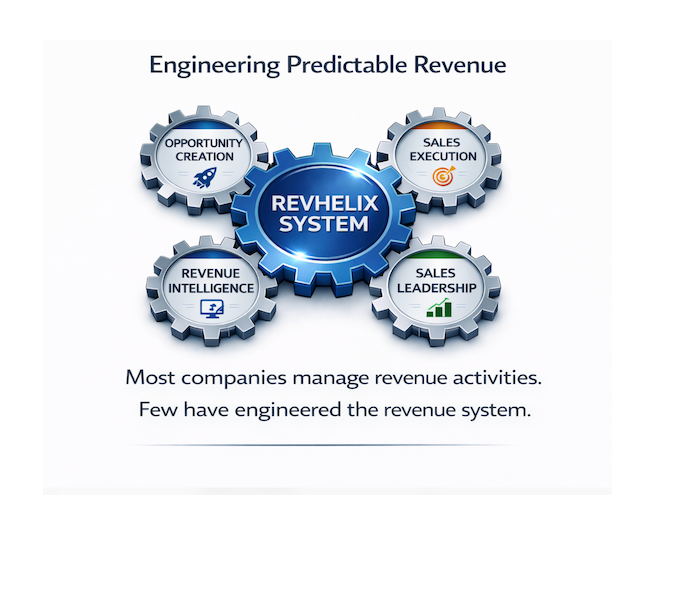
Figure 1: The RevHelix System. Most companies manage revenue activities. Few have engineered the revenue system.
Fix the constraint. The system performs.
How to Fix Outbound Performance
To improve outbound, you must fix the system that drives it.
That means:
- defining a precise ICP
- aligning messaging to real business problems
- implementing structured outreach systems
- enforcing qualification discipline
- aligning outbound with sales execution
At AGS, this is part of Precision Pipeline Generation. This isn’t about “doing more”; it’s about transforming how leads are generated through technical precision.
? Improve pipeline → Precision Pipeline Generation Solutions
MID-ARTICLE CTA
If outbound isn’t producing pipeline, your system is constrained.
? Get Your Revenue System Assessed
The Key Insight
Outbound doesn’t fail randomly.
It fails when the system behind it is misaligned.
More activity does not fix this.
? Better system design does.
Related Revenue System Components
If outbound isn’t working, the issue may not be pipeline alone. Consider these critical systemic checks:
- Fix conversion → Sandler Sales Training & Execution
- Improve forecasting → Revenue Operations & Strategy
- Improve CRM visibility → Data-Driven Marketing Impact
If Pipeline Isn’t Predictable, the System Isn’t Working
Most companies respond to outbound failure with more effort.
More emails. More calls. More tools.
But effort does not fix structural issues.
Until the constraint is identified, outbound will remain inconsistent. You are essentially trying to drive a car with square wheels by pushing the accelerator harder. The solution isn’t more horsepower; it’s changing the wheels.
Revenue is not a matter of luck or heroics. It is an engineering outcome. If your outbound isn’t working, stop the activity and start the audit. Locate the constraint, realign the messaging, and build a high-converting funnel that operates with mechanical predictability.
FINAL CTA
? Get Your Revenue System Assessed
Identify the constraint limiting your pipeline, conversion, and revenue performance.