
You are not losing deals at the end.
You are losing them much earlier.
Late-stage deal loss is one of the most misunderstood problems in B2B sales. It is frequently diagnosed as a “closing” issue, a failure of the salesperson to apply enough pressure or “handle objections” at the goal line. This diagnosis is incorrect. It is a failure of Revenue Architecture.
From the outside, these opportunities appear robust. The buyer is engaged. The opportunity is documented. The technical fit is confirmed. Then, the silence begins. The deal stalls. It slips. It disappears into the void of “no decision.”
The predictable corporate reaction is to demand better closing techniques. This is a waste of resources. You cannot close a deal that was never structurally sound to begin with. Late-stage failure is almost always the result of an early-stage mechanical defect.
WHAT “LATE-STAGE STALL” ACTUALLY LOOKS LIKE
Most companies do not categorize these situations as “lost.” They categorize them as “delayed.”
The deal is pushed to next quarter. It is delayed indefinitely for “internal reasons.” It is stuck in a permanent state of negotiation. It is perpetually waiting on a final executive signature that never arrives.
On your dashboard, the pipeline looks healthy. The weighted forecast suggests a windfall is imminent. But the revenue never hits the bank. This discrepancy creates a cascading failure across the entire organization:
- Unreliable forecasts: Leadership makes hiring and investment decisions based on phantom numbers. Read more on /why-forecasts-are-wrong.
- Inflated pipeline: The sales team feels a false sense of security, ignoring the reality that their “active” deals are actually “zombie” deals. See /why-pipeline-doesnt-equal-revenue.
- Pressure to generate more pipeline: To compensate for the “slow” closing, the system demands more B2B Lead Generation Services to fill the gap. Explore /b2b-lead-generation.
The cycle continues because the root cause remains unaddressed.
THE REAL PROBLEM
Late-stage deals do not stall because of a lack of closing skill. They stall because they were never legitimate opportunities to begin with.
This is a clinical reality that many sales organizations refuse to accept. A deal that stalls in the late stage is a deal that lacked structural integrity at its foundation. Most of these “stalled” opportunities suffer from four primary defects:
- Weak Qualification: The criteria for what constitutes a “deal” are too low.
- Unclear Buyer Commitment: The prospect was “interested” but never committed to a change.
- Lack of Real Urgency: The cost of the status quo was never quantified or accepted by the buyer.
- No Defined Decision Process: The salesperson is guessing how the buyer buys.
They were allowed to progress through the pipeline anyway because the system prioritizes activity over accuracy. This is where the revenue machine breaks.

HOW BAD DEALS ENTER YOUR PIPELINE
Deals do not suddenly become weak at the 90% mark. They enter the pipeline weak at the 10% mark.
When your Revenue Engineering is flawed, “garbage” is allowed to masquerade as “growth.” This happens in three specific ways:
Inconsistent Qualification
Reps interpret qualification through the lens of optimism rather than evidence. Without a standardized diagnostic framework, some reps push deals forward too early, while others remain disciplined. This lack of uniformity makes the pipeline impossible to manage. This is a primary focus of effective /sales-training.
Meetings Treated as Opportunities
Activity is mistaken for progress. A good conversation or a successful demo is recorded as a “deal.” In reality, a conversation is just a conversation. Until a buyer commits to a specific sequence of next steps, no opportunity exists. This fills the pipeline with low-probability noise.
No Enforcement of Standards
Leadership often reviews the size of the pipeline rather than the quality of the deals. When weak deals are allowed to remain in the “Active” stage for months without progress, the system loses its predictive power. This failure in leadership often points to a need for better /sales-recruitment to find managers who prioritize discipline over hope.
WHY THEY STALL LATE
By the time a deal reaches the final stages of your sales process, the structural rot is already baked in. You aren’t experiencing a “closing” problem; you are experiencing the inevitable conclusion of a failed discovery process.
In the late stage, you see the symptoms:
- The actual decision-makers: the ones who control the budget: were never fully engaged.
- The budget was “assumed” but never strictly confirmed through a formal process.
- The urgency was imagined by the salesperson, not validated by the buyer’s pain.
- Next steps were vague, leading to “ghosting” when the buyer reached the point of maximum perceived risk.
When the pressure to sign increases, the deal collapses under its own weight. Late-stage stalls are actually early-stage failures in disguise.
THE ROLE OF EXECUTION DISCIPLINE
Execution discipline is the governor of your revenue machine. It determines which deals are permitted to enter the pipeline and how they are handled. Without structure, salespeople will default to “heroics”: trying to save bad deals with discounts and pressure.
At Sandler Atlantic, we emphasize that deal control is gained or lost in the first twenty minutes of the first meeting. Frameworks like the Sandler Selling System are designed to prevent late-stage stalls by enforcing:
- Strict Qualification: Using the BAT Triangle (Budget, Authority, Need) to disqualify early.
- Up-Front Contracts: Ensuring every interaction ends with a clear, mutually agreed-upon next step.
- Negative Reverses: Testing the buyer’s commitment to change before investing resources.
- Buyer Accountability: Ensuring the buyer does as much work as the seller.
Without this level of execution discipline, late-stage failure is a mathematical certainty.
WHAT THIS LOOKS LIKE IN PRACTICE
You have heard these post-mortem excuses before:
“We had a great conversation and they loved the demo… then they just went quiet.”
“They said they were definitely interested and would get back to us… but nothing moved forward.”
“It felt like a very strong deal, the champion was on our side… but it slipped again this month.”
These are not random anomalies or “bad luck.” They are predictable outcomes of weak deal construction. If you find yourself “waiting” for a buyer to do something, you have already lost control of the deal. Control is not something you apply at the end; it is something you establish at the beginning.
WHY MORE PIPELINE MAKES IT WORSE
When deals do not close, the typical executive response is to demand more B2B Lead Generation Services. The logic is: “If our win rate is low, we just need more at the top of the funnel.”
This is a catastrophic error in Revenue Architecture. If your qualification process is weak, adding more leads to the top only increases the volume of bad deals in the middle. This results in:
- Lower Win Rates: Your team spends 80% of their time on deals that will never close. See /sales-training.
- Increased Noise: Real opportunities get lost in the sea of “zombie” deals.
- Decreased Forecasting Accuracy: The more “bad” deals you have, the more volatile your revenue becomes. Read about the role of /revenue-operations in managing this data.
Generating more pipeline before fixing your execution discipline is like pouring more fuel into a broken engine. You don’t get more speed; you just get more smoke.
HOW THIS CONNECTS TO YOUR SYSTEM
Late-stage deal failure is a systemic infection. It does not stay contained within the sales department.
If deals are weak, the pipeline becomes inflated. If the pipeline is inflated, the revenue forecast becomes a work of fiction. When the forecast fails, the executive team loses confidence in the sales organization’s ability to scale. This leads to erratic decision-making, budget cuts, or unnecessary pivots.
This is the “Revenue Constraint.” Every organization has one primary bottleneck that limits growth. For many, that constraint is the inability to distinguish between a “lead” and a “deal.” To see how these components interact, view our /revenue-constraint framework.
THE REAL FIX
You do not fix late-stage deals at the end of the process. You fix them at the entry point.
Precision Pipeline Generation requires a shift from a “selling” mindset to a “diagnostic” mindset. You must treat every prospect as a patient and your solution as a high-stakes surgery. If they don’t need the surgery, or if they can’t afford the recovery, they shouldn’t be in the operating room.
The fix requires:
- Consistent Qualification Criteria: Removing subjectivity from the pipeline.
- Clear Definition of Opportunity: A deal is only a deal if there is documented evidence of pain and budget.
- Disciplined Progression: No deal moves forward without a signed Up-Front Contract for the next step.
- Enforced Accountability: Sales leadership must inspect the “how” and “why” of every deal, not just the “how much.”
This approach ensures fewer deals enter the pipeline, but the ones that do actually close.
https://cdn.marblism.com/B0vQ_iZezKw.png
DECISION MOMENT
If your deals are stalling in the late stage, the question you must ask is not: “How do we close better?”
The question is: “Why are weak deals being allowed into our pipeline in the first place?”
Until you answer that question and adjust your Revenue Architecture accordingly, you will continue to experience the frustration of stalled deals, missed forecasts, and inconsistent revenue. The “closing” problem is a ghost. The “qualification” problem is the reality.
TRANSITION TO DIAGNOSTIC
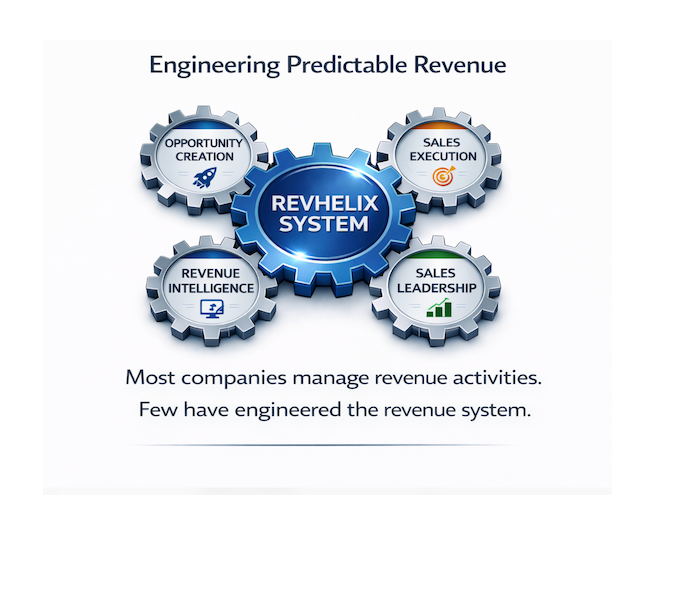
This is exactly what the RevHelix Diagnostic identifies. We do not look at your sales team’s “personality”; we look at your revenue machine’s “mechanics.”
The diagnostic evaluates the four critical pillars of your system:
- Pipeline Quality: Are your B2B Lead Generation Services producing high-intent opportunities? /b2b-lead-generation
- Execution Discipline: Is your team following a rigorous sales methodology like Sandler Atlantic? /sales-training
- Leadership Enforcement: Are your managers enforcing standards or just acting as “super-closers”? /sales-recruitment
- Forecasting Accuracy: Is your data providing a clear path to revenue or just clouding the view? /revenue-operations
We isolate the structural constraint limiting your growth and provide the engineering plan to remove it.
If deals are stalling in the late stage, your system is already in a state of failure. The longer you wait to fix the structural defects at the top of the funnel, the more revenue you will leave on the table.
Stop guessing why your pipeline isn’t converting. Get the facts.