
Most B2B revenue leaders treat their pipeline like a collection of stories. They look at deal names, recall conversations, and apply a layer of optimism to determine if they’ll hit their number. This is not leadership; it is hope-based management. In a high-performance Revenue System, revenue is not an event, it is a mathematical outcome of specific structural inputs.
The most critical of these inputs is pipeline coverage.
If your coverage is too thin, your sales team is forced into “heroics” to close the gap, discounting, skipping discovery, or chasing bad-fit deals. If your coverage calculation is based on inflated “weighted” probabilities that don’t reflect reality, you are flying blind into a quarterly miss.
To build a predictable revenue engine, you must move away from the “3x coverage” myth and start engineering your pipeline coverage based on the cold, hard physics of your specific sales cycle.
The Basic Mechanics: What is Pipeline Coverage?
At its simplest level, pipeline coverage is a ratio. it measures how much “qualified” opportunity you have in the hopper relative to the revenue target you are expected to hit within a specific timeframe.
The Basic Formula:
Pipeline Coverage Ratio = Total Qualified Pipeline Value / Sales Quota
For example, if your quota for the quarter is $1M and you have $3M in qualified pipeline, you have 3x coverage. This suggests that you only need to win 33% of your active deals to hit your target.
However, the “Basic Formula” is where most companies stop, and it’s also where the structural failures begin. The problem isn’t the math; it’s the variables. If “Total Qualified Pipeline” includes “zombie deals”, opportunities that haven’t moved in 90 days but are still sitting in the CRM, the ratio is a lie.

The “3x Coverage” Myth: Why Your Multiplier is Probably Wrong
For decades, “3x coverage” has been the industry standard. It’s a legacy benchmark from 1990s enterprise software sales. In the modern B2B landscape, blindly aiming for 3x coverage is a recipe for a catastrophic shortfall.
Your required coverage is not a static number. It is a derivative of your Win Rate.
If your team wins 50% of the deals they touch, you only need 2x coverage to hit your number. If your win rate is 20%, 3x coverage ensures you will miss your quota by exactly 40%. To hit a $1M target with a 20% win rate, you don’t need $3M in the pipe, you need $5M.
Calculating Your Required Coverage Multiplier
To find your true structural requirement, use this calculation:
Required Coverage = 1 / Your Segment Win Rate
- Win Rate 50%: 1 / 0.50 = 2x Coverage Required
- Win Rate 33%: 1 / 0.33 = 3x Coverage Required
- Win Rate 20%: 1 / 0.20 = 5x Coverage Required
- Win Rate 10%: 1 / 0.10 = 10x Coverage Required
If you do not know your win rate by segment (SMB vs. Enterprise), you do not have a pipeline; you have a pile of data. Predictive Pipeline Architecture requires that you calculate these multipliers separately for every distinct motion in your business.
Weighted vs. Raw Coverage: The Probability Trap
Many organizations use “weighted pipeline” to forecast. This involves multiplying the deal value by a percentage based on its CRM stage (e.g., Discovery = 10%, Proposal = 50%, Negotiation = 80%).
While this looks scientific on a spreadsheet, it often masks structural defects in the sales process.
A $100k deal at the “Proposal” stage is not worth $50k to the business. It is either worth $100k or $0. When you aggregate these percentages across a large enough sample size, the law of averages is supposed to take over. However, if your sales team is not using a rigorous methodology, like Sandler Sales Training, those stage percentages are usually based on “seller feeling” rather than objective buyer actions.
The Diagnostic Fix: Stop relying on weighted coverage for short-term predictability. Use Raw Coverage of qualified opportunities to determine if you have enough “at-bats,” and use Weighted Coverage only as a secondary check for long-term trend analysis.
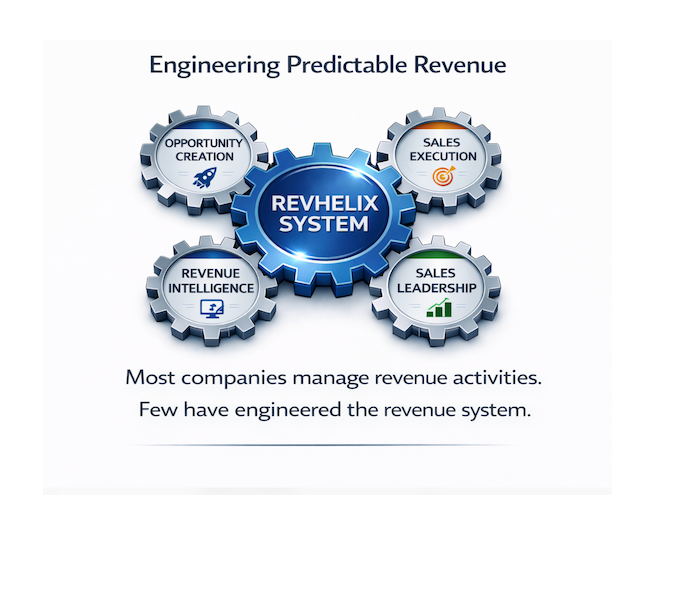
Structural Engineering: Land, Expand, and Consolidate
To stabilize your coverage math, you must look at the pipeline through a structural engineering framework:
1. Land (Data Integrity)
Before you calculate coverage, you must scrub the reservoir. Any deal that has exceeded your average sales cycle by 50% without a clear “Up-Front Contract” (a Sandler principle) should be removed from the coverage calculation. This is “Pipeline Noise.” It dilutes your signal and makes the engine look more powerful than it actually is.
2. Expand (Precision Pipeline Generation)
Once you know your true multiplier (e.g., 4x), you can work backward to determine how much new pipe needs to be created every month. This is where Revenue Engineering replaces “Lead Gen.”
If your average deal size is $50k and you have a $1M quarterly quota, you need 20 wins. If your win rate is 25%, you need 80 qualified opportunities in the pipe. If you currently have 40, your “Coverage Gap” is 40 deals or $2M. You now have a clear engineering requirement for your Precision Pipeline Generation efforts.
3. Consolidate (The Authority Loop)
Coverage isn’t just about the top of the funnel. You must link your pipeline math to your Sales Health Assessment. If your coverage is 5x but your win rate is dropping month-over-month, the problem isn’t “not enough leads”, it’s a failure in sales execution or a mismatch in ICP (Ideal Customer Profile) targeting.

Variables That Break the Math
A formula is only as good as the integrity of the variables. In our work at Atlantic Growth Solutions, we frequently see three specific mechanical failures that break pipeline coverage math:
- The “Big Fish” Distortion: One massive deal that represents 50% of the total pipeline value. If that deal slips, the coverage for the entire quarter collapses. The Fix: Calculate coverage with and without your top two outliers to see the “true” health of the run-rate business.
- Mismatched Timeframes: Calculating coverage for the next 30 days using deals that have a 90-day sales cycle. The Fix: Ensure your coverage measurement period matches your actual cycle length.
- Low-Velocity “Parked” Deals: Opportunities that aren’t “Closed-Lost” but aren’t moving. They stay in the pipe because reps don’t want to admit a loss. The Fix: Implement strict “Negative Reverses” (Sandler) to disqualify deals early. If it’s not a “Yes,” it’s a “No”, stalling is the most expensive outcome in sales.
Benchmarks: What Good Looks Like
While every business is unique, a healthy, tech-enabled revenue engine generally falls within these coverage parameters:
- High-Velocity SMB (30-day cycles, 50% win rates): 1.7x to 2.5x coverage.
- Mid-Market (60-90 day cycles, 30% win rates): 3x to 4x coverage.
- Enterprise (6-12 month cycles, 15-20% win rates): 5x to 7x coverage.
If you are operating below these thresholds, your revenue is at risk. You are essentially gambling that your sales team will perform at “heroic” levels to hit a number that the system was not engineered to support.

Conclusion: Stop Guessing, Start Engineering
Calculating pipeline coverage is the first step in moving from a sales “culture” to a sales “system.” It forces a level of honesty that most organizations avoid. It highlights exactly where the revenue engine is leaking and quantifies the cost of those leaks.
If you are unsure of your true multiplier, or if your “3x coverage” consistently fails to produce 100% quota attainment, the problem is structural. You don’t need more activity; you need a more precise architecture.
Next Steps for the Revenue Architect:
- Audit your Win Rate: Look at the last four quarters of data. Divide closed-won deals by the total number of qualified opportunities created in that period.
- Define your Multiplier: 1 / [Your Win Rate].
- Scrub the Noise: Remove any deal from your CRM that hasn’t moved in the last 30 days.
- Recalculate Coverage: Do you actually have the pressure in the system to hit your goal?
If the math doesn’t add up, it’s time for a diagnostic intervention. Stop managing the activities and start engineering the system.