
Most B2B organizations treat sales leadership as a motivational exercise. They hire a “rockstar” VP, expect them to give a few speeches, join late-stage calls to “close the deal,” and ride the team to hit a number that was likely pulled from a spreadsheet without regard for reality.
This is the “heroic” model of sales management. It is also a primary cause of revenue volatility.
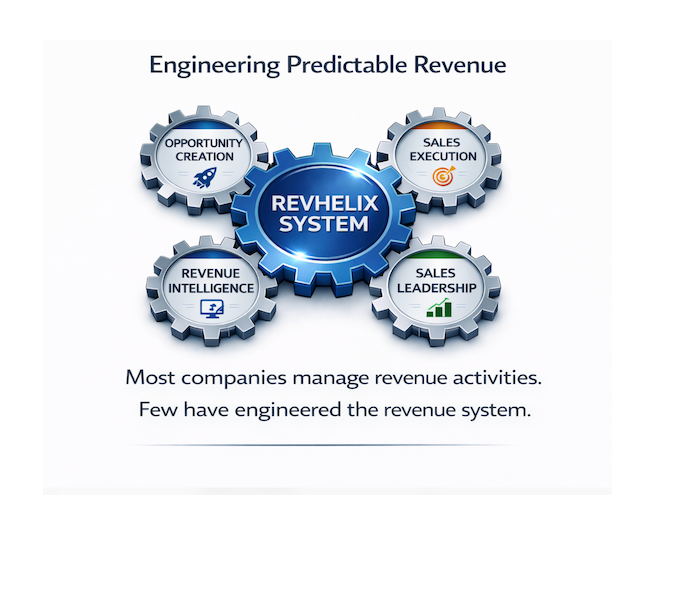
In a high-performing Revenue System, leadership is not about personal charisma or individual heroics. It is the governor of a machine. It is the layer of the system that ensures the engine runs at the correct RPM, maintains the prescribed tolerances, and prevents mechanical failure.
When sales teams underperform, the issue is rarely a lack of talent. It is almost always a failure of the managed system: a lack of cadence, accountability, and inspection discipline.
The shift from sales heroics to revenue engineering
Strong sales leadership begins with a fundamental realization: you are not managing people; you are managing a process that people execute. If the process is broken, the best people in the world will eventually fail.
The “Revenue Architect” does not look for heroes to save the quarter. They look for constraints in the system. They ask why the pipeline is inconsistent, why deals stall in the middle stages, and why the CRM data looks like fiction.
Leadership’s primary job is to support the system. This means protecting the standards of the Revenue System and ensuring that every rep has a clear, frictionless path to execution. If a rep is failing, the leader first diagnoses the system: Did we provide a clear ICP? Is the messaging surgical? Is the qualification framework (Sandler) being enforced? If the system is sound and the rep still fails, then: and only then: is it a talent issue.
The management cadence: the heartbeat of the engine
A revenue engine without a cadence is just a collection of random activities. Strong leadership installs a predictable rhythm of inspection and coaching. Without this, “drift” occurs: reps start taking shortcuts, qualification weakens, and the forecast becomes a hope-based document.
What does a high-performance management cadence look like? It follows a structural framework:
The weekly pipeline inspection
This is not a “status update” meeting. In a managed system, the leader already knows the status of the deals because the CRM is the single source of truth. The weekly inspection is a diagnostic session.
- Focus: Is the pipeline healthy? Are new opportunities being created at the required velocity?
- Action: Inspect the top of the funnel and late-stage deals. Look for “stale” opportunities that haven’t moved in 14 days.
- Sandler Principle: Use “Up-Front Contracts” to ensure every deal has a clear next step and a defined date for the next interaction.
The monthly coaching deep-dive
If the weekly meeting is about the “what,” the monthly meeting is about the “how.” This is where the leader acts as a coach, focusing on skill development and methodology.
- Focus: Behavior, Technique, and Attitude (The Sandler BAT Triangle).
- Action: Review call recordings or sit in on discovery sessions. Are the reps using Negative Reverses? Are they uncovering the true “Pain,” or are they just pitching features?
- Outcome: A specific development plan for the next 30 days.
The quarterly revenue architecture review
Every 90 days, leadership must step back from the daily execution to look at the structural integrity of the entire system.
- Focus: Is the Revenue System still aligned with the market?
- Action: Audit the win/loss ratios, average deal size, and sales cycle length. Identify if a new constraint has emerged in the pipeline or conversion layers.
- Tool: Use the Revenue Impact Calculator to quantify the cost of current system leaks.
Accountability is a structural requirement
Accountability is often misunderstood as “punishment for missing quota.” In reality, true accountability is the consistent enforcement of the system’s standards.
Strong sales leaders hold their teams accountable to the process first, and the result second. If a rep follows the system perfectly and misses their number, the system needs an adjustment. If a rep hits their number but ignores the system: skipping CRM entries, ignoring qualification steps, “winging” it on calls: they are a liability. They are creating “unmanaged” revenue that cannot be forecasted or scaled.
CRM integrity as a leadership standard
The CRM is not an administrative burden; it is the dashboard of the revenue engine. A leader who tolerates a messy CRM is a leader who is flying blind.

Technical Diagram: A snapshot of a CRM-first culture showing 100% stage accuracy and automated activity logging.
Strong leadership mandates that if it isn’t in the CRM, it didn’t happen. This isn’t about micromanagement; it’s about data integrity. Without accurate data, you cannot calculate pipeline coverage or build a reliable forecast.
How leadership supports the system, not just the reps
Most sales managers think their job is to help reps close deals. While that’s part of it, the real value of a leader lies in removing the friction that slows the team down. This involves three key areas:
- Territory and Lead Allocation: Ensuring the Precision Pipeline Generation efforts are feeding the right reps the right opportunities.
- Sales Enablement: Providing the surgical tools: the playbooks, the messaging, the technical specs: that allow a rep to move from discovery to close with minimal drag.
- Removing Non-Sales Friction: Dealing with internal hurdles (legal, finance, product) so the sales team can focus on revenue production.
When leadership focuses on the system, they create a “managed environment” where average reps can become high performers, and high performers can become elite.
The leadership benchmark: what “good” looks like
To move from a chaotic sales environment to a managed revenue system, you need to measure your leadership against clear benchmarks. Strong sales leadership is characterized by:
- Forecast Accuracy: Being within 5-10% of the predicted revenue every month because the system is predictable.
- Methodology Adoption: 100% of the team using a common language (Sandler) for qualification and deal progression.
- Turnover Stability: A high-performance culture that retains top talent because the system is fair, predictable, and supportive.
- Pipeline Health: A consistent ratio of qualified opportunities to quota, preventing the “end-of-quarter” scramble.
If your current leadership model relies on heroics, late-night “war rooms,” and inconsistent results, your revenue engine has a structural defect at the leadership layer.
Diagnose your leadership constraint
Revenue performance is constrained by system design. Leadership is the layer that ensures that design is executed flawlessly. If you are struggling with sales team accountability or inconsistent pipeline, the problem isn’t your people: it’s the system they are operating in.
The first step in fixing a broken sales culture is a clinical diagnosis. You must identify exactly where the friction is occurring and which leadership levers need to be adjusted.
Start Your Revenue System Diagnostic
Are your leaders managing the system or just chasing the number? Use our Sales Health Assessment to get a clinical breakdown of your leadership, pipeline, and conversion layers.

Estimate Revenue at Risk
If your leadership cadence is failing, how much revenue are you leaving on the table? Use our Revenue Impact Calculator to quantify the cost of your current system constraints.
Leadership is the difference between a collection of individuals and a revenue machine. Stop hoping for heroes. Start engineering a system that performs.