
Activity is a vanity metric. Revenue is a structural outcome.
Most B2B organizations are currently trapped in a “volume cycle.” They believe that if they double their outbound activity: more dials, more emails, more LinkedIn connections: the revenue will naturally follow. This is a mechanical misunderstanding of how a Pipeline Architecture actually functions.
When your outbound engine is running at high RPMs but producing zero torque, you don’t have a motivation problem. You have a structural defect. You are likely measuring the wrong inputs and ignoring the friction points that are bleeding your margin.
In this diagnostic report, we will strip away the “heroic” sales myths and look at outbound through the lens of Revenue Engineering.
Land: The Diagnosis of Activity Rot
If you are seeing high activity levels from your Business Development Representatives (BDRs) but your “Closed-Won” column remains stagnant, you are witnessing “Activity Rot.” This occurs when the sales motion is disconnected from the revenue reality.
1. The Volume Fallacy
The most common structural failure in B2B sales is the belief that outbound is a numbers game. It is not. It is a relevance game.
When you push for volume, you incentivize your team to take the path of least resistance. They target “easy” leads rather than “right” leads. They use generic messaging that can be blasted to thousands, rather than precision narratives that resonate with a specific ICP (Ideal Customer Profile). The result is a flooded top-of-funnel filled with noise, which eventually chokes your Account Executives (AEs) with unqualified meetings.
2. Data Integrity as a Structural Constraint
You cannot build a high-performance engine on contaminated fuel. Most outbound failures start with a “Data Integrity Protocol” breakdown. If your CRM is filled with outdated titles, incorrect direct dials, or companies that no longer fit your ICP, your reps are spending 80% of their “activity” time performing manual data cleanup.
This isn’t sales; it’s expensive clerical work. A lack of HubSpot Integrity Protocol means your forecasting is based on hope rather than data truth.

3. The ICP Drift
Market conditions change. If your targeting hasn’t been re-engineered in the last six months, you are suffering from ICP Drift. You are solving problems that your prospects no longer have, or you are targeting personas whose budgets have been reallocated to different departments.
Expand: The Mechanics of Precision Pipeline Generation
To fix the revenue leak, you must move away from “Lead Gen” thinking and embrace Precision Pipeline Generation. This requires a shift from activity-based management to outcome-based engineering.
Engineering the Value Narrative
Messaging is the lubricant of the revenue machine. If it’s too thick (too much technical jargon) or too thin (too generic), the machine seizes.
Stop “checking in” and start “providing insight.” Your outbound outreach must lead with a problem the prospect doesn’t realize they have, or a solution to a constraint that is currently capping their growth. This is the difference between being a “vendor” and a “strategic asset.”
The Sandler Integration: Technique Over Talent
At Atlantic Growth Solutions, we apply Sandler Sales Training principles to ensure that every touchpoint serves a purpose.
- The BAT Triangle: You must balance Behavior (the activity), Attitude (the mindset), and Technique (the execution). If you only focus on Behavior, you get high activity with low conversion.
- Up-Front Contracts: Your reps must stop “hoping” for a next step and start “engineering” it. Every call should end with a clear, mutually agreed-upon next action.
- Negative Reverses: Instead of chasing a prospect, your reps should be trained to “pull back.” If a prospect isn’t a fit, the system should identify that immediately and eject them from the funnel to save resources.
Quality Benchmarks: What “Good” Looks Like
A healthy pipeline is not defined by its size, but by its velocity and conversion integrity.
- Connect-to-Meeting Ratio: If this is below 10%, your messaging or your data is the constraint.
- Meeting-to-Opportunity Ratio: If this is below 50%, your “qualified” criteria are too loose. You are booking meetings, not building a pipeline.
- Opportunity-to-Close Ratio: This tells you if your AEs are equipped to handle the handoff or if there is a fundamental mismatch between what was promised and what can be delivered.
Consolidate: Building the Authority Loop
A standalone outbound motion is a fragile one. For outbound to create sustainable revenue, it must be part of a larger Pipeline Architecture.
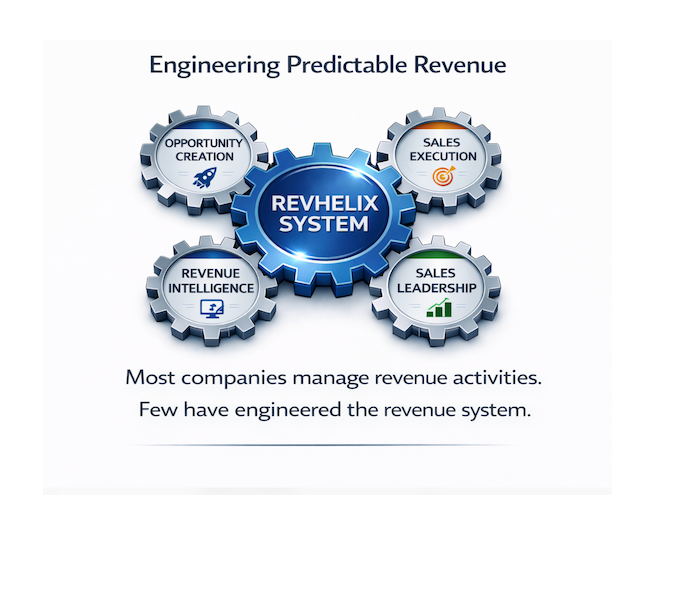
The Revenue System Framework
Revenue is a system of interconnected constraints. If you fix outbound but your conversion process is broken, you have simply moved the bottleneck.
- Pipeline Architecture: Focuses on the top-of-funnel flow. This is where Precision Pipeline Generation lives.
- Conversion Architecture: Focuses on how those leads are nurtured and closed.
- Forecast Architecture: Ensures the data in your CRM is a “truth source” for the executive team.
- Leadership Architecture: Ensures the team is managed through systems, not heroics.
By viewing these as an integrated machine, you can identify exactly where the “friction” is occurring. Is it a lack of leads? (Pipeline). Is it a failure to close? (Conversion). Or is it a management failure to enforce the process? (Leadership).

How to Fix Your Outbound Engine
If your outbound activity is not creating revenue, do not tell your reps to work harder. Harder work on a broken system only produces more broken outcomes. Instead, follow this remediation sequence:
- Conduct a Sales Health Assessment: You cannot fix what you haven’t diagnosed. You need a clinical audit of your current system to identify the specific structural defects. Start your assessment here.
- Standardize the Integrity Protocol: Clean your data. Define your ICP with surgical precision. If a lead doesn’t fit the criteria, it doesn’t enter the system.
- Audit the Messaging: Remove the fluff. Lead with the “Cost of Inaction.” If the prospect stays with their current status quo, what does it cost them in terms of time, money, or market share?
- Implement Sandler Techniques: Train your team on the “Up-Front Contract” and “Negative Reverse.” Shift the power dynamic from “begging for time” to “offering a solution.”
- Focus on “Revenue Intelligence”: Use your CRM to track the health of the system, not just the activity of the reps. If the data says a channel isn’t producing revenue, kill it.
The Cost of Inaction
Every day you allow an inefficient outbound engine to run, you are burning cash and eroding your brand’s reputation in the market. You are also burning out your best talent, who will eventually leave for an organization that has a functioning system.
The “Hero” salesperson is a myth. The “Revenue Engineer” is the reality. Stop looking for a rockstar to save your company and start building a system that makes rockstars irrelevant.
Related System Constraints:
- Pipeline Architecture Hub
- How to Fix Forecast Accuracy
- Why Your B2B Sales Strategy Isn’t Scaling
- Revenue System Architecture Hub
One Sentence: You have built the system: now you must remove the signal noise to let the revenue flow.