
Most B2B revenue engines are not engines at all. They are collections of disconnected parts held together by hope and quarterly “heroics.” When a pipeline dries up, the standard response is a frantic increase in activity or a demand for more top-of-funnel volume. These are cosmetic fixes for structural failures.
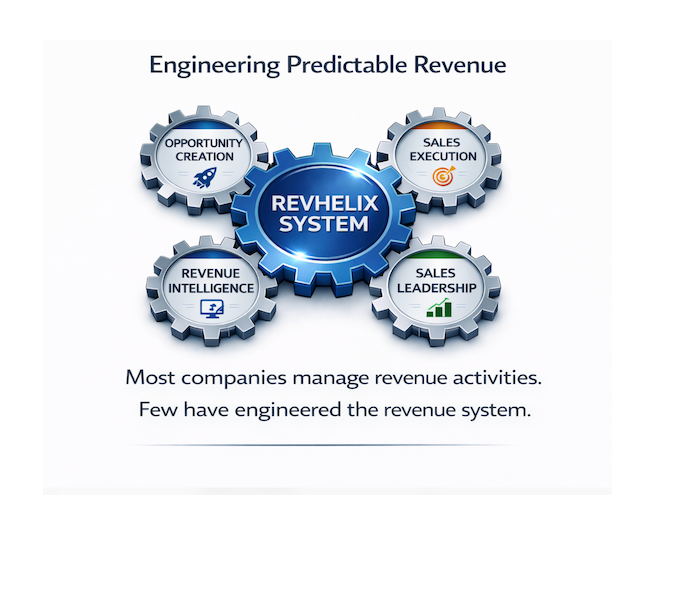
To achieve predictable growth, Revenue Engineering must be treated as a rigorous engineering discipline. It is the structural flow of intent, captured, qualified, and accelerated into a high-fidelity pipeline. If revenue generation is inconsistent, the problem is not visibility. It is a mechanical defect in pipeline design.
The Diagnostic: Why Traditional Pipeline Creation Fails
Traditional pipeline creation often operates on vanity metrics: impressions, clicks, and the ubiquitous “Lead.” In a B2B context, a “Lead” is often nothing more than a name with no verified pain, no urgency, and no decision path. Pursuing these metrics creates noise, not revenue.
Structural failure in the pipeline occurs when there is a lack of alignment between signal capture and sales execution. Most organizations suffer from:
- Gaps in Revenue Math: An inability to trace a closed-won deal back to the specific outreach, source, or conversation that initiated the buying motion.
- Weak ICP Fidelity: Targeting “everyone” in a vertical rather than the specific buying committee members with measurable pain and relevance.
- Frictional Handoffs: A lack of an Up-Front Contract between commercial functions regarding what constitutes a qualified opportunity.
Revenue Engineering only works when it is built as a Precision Pipeline Generation system. Do not look for “engagement.” Look for structural integrity.
Land: The Architecture of Revenue Math
The first phase of engineering a Revenue Engineering system is the “Land” phase, establishing the foundation. This begins with the math.
Before a single campaign is launched or an outbound sequence is deployed, the Revenue Architect must calculate the required pipeline volume based on ARR targets, average contract value (ACV), and historical win rates. If your target is $5M in new business and your average win rate is 20%, you require a $25M qualified pipeline. Engineering back from that number dictates the necessary flow rate of your Revenue Engineering system.
At this stage, we define the Dynamic ICP. Static firmographics are insufficient. We must identify the technographic context, buying roles, and operational signals that indicate a problem exists within the prospect’s organization. In the Sandler Atlantic framework, we look for pain, budget reality, and decision structure. Revenue Engineering is the process of identifying that pain at scale before a human conversation advances.
Expand: Engineering the Multi-Channel Flow
Once the foundation is set, the system must “Expand” to capture intent across the market. This is not about being everywhere; it is about reaching the buying committee with surgical precision.
1. High-Intent Capture
Revenue Engineering distinguishes between noise and active buying motion. High-intent capture focuses on accounts already showing symptoms of need. This involves structured Revenue Engineering that combines targeting, qualification, and channel discipline to intercept prospects at the moment of diagnostic need.
2. The Conversation Asset as a Tool
In a structural engineering framework, every asset is a tool designed to perform a specific function: moving a prospect from one stage of the pipeline to the next.
- Awareness Assets: Diagnose the problem the prospect did not know they had.
- Consideration Assets: Quantify the cost of inaction.
- Decision Assets: Provide the validation required for the buying committee to proceed.
3. Orchestration vs. Automation
Automation is a force multiplier, but it cannot fix a broken process. Treat AI and automation as execution tools. Human judgment remains the strategic constraint. A Precision Pipeline Generation engine uses automated sequences to maintain flow, but relies on human intervention to validate pain, enforce Up-Front Contracts, and deploy Negative Reverses when fit is weak.

Consolidate: The Feedback Loop and Revenue Intelligence
The final phase is “Consolidate.” A system without a feedback loop is a system that eventually fails. Revenue Engineering must be instrumented to provide Revenue Intelligence back to the leadership team.
Every touchpoint must be tracked. If a specific channel is producing high volumes of contacts that fail to progress past the first discovery call, that channel is structurally unsound. It must be decommissioned or re-engineered.
This is where Precision Pipeline Generation becomes useful only when integrated with sales discipline. Atlantic Growth Solutions aligns targeting and qualification with the realities of the sales floor. We use Negative Reverses in messaging, calling out who the offer is not for, to ensure that only high-fidelity opportunities enter the pipeline. This reduces waste and increases sales velocity.
The Strategic Constraint: Human Expertise
While the system handles the structural flow of data and intent, the ultimate constraint in any B2B sale is human expertise. Technology can identify a prospect and track engagement, but it cannot navigate the politics of a 10-person buying committee.
At Atlantic Growth Solutions, technology-enabled execution supports human mastery. Our Revenue Engineering approach ensures that sales professionals are not wasting time on unqualified contacts but are instead engaging with qualified opportunities vetted for fit, pain, and commercial relevance.

Structural Audit: Is Your Pipeline Sound?
To determine if your Revenue Engineering system is functioning or merely hiding defects, ask the following diagnostic questions:
- Can you quantify the cost of a lost opportunity at each stage of your pipeline?
- Is your sales team ignoring more than 20% of the opportunities generated by your Precision Pipeline Generation system?
- Do you have a documented Up-Front Contract between pipeline creation and sales regarding opportunity fidelity?
- Can you trace the technical path from first signal to closed revenue without relying on assumptions?
If the answer to any of these is “no,” your pipeline has a structural leak.

Conclusion: Stop Chasing Activity. Start Engineering.
Revenue Engineering is not a creative exercise. It is the clinical application of data, targeting, qualification, and structural flow to the problem of B2B revenue. By shifting from a campaign mindset to a Revenue Engineering mindset, organizations can stop the cycle of feast and famine and begin to build a predictable, scalable asset.
Atlantic Growth Solutions is designed to diagnose these failures and implement the necessary structural repairs through Revenue Engineering and tech-enabled human expertise. Do not ask for more activity. Demand better architecture.
To begin a structural audit and transition to Precision Pipeline Generation, contact our team of Revenue Architects. Your revenue is a machine. Treat it like one.