
Revenue is not an abstract outcome of effort; it is the output of a machine. Like any mechanical system, a revenue engine is subject to the laws of physics. The most destructive force acting against your growth is friction. In a sales context, friction manifests as Velocity Erosion.
When your sales cycle stretches from four months to six, or from six to nine, your organization is suffering from a structural failure. This is not a “market condition” or a “buyer hesitation” issue. It is a diagnostic sign that your Revenue Architecture is leaking energy.
Sales velocity is calculated with clinical precision: (Number of Opportunities × Average Deal Value × Win Rate) / Length of Sales Cycle. If the denominator: the time it takes to move from first touch to closed-won: increases, your velocity collapses. Most leadership teams attempt to compensate for this by stuffing more “leads” into the top of the funnel. This is a fatal error. It is equivalent to adding more fuel to an engine with a seized transmission.
The Pipeline Delusion: Volume vs. Velocity
The “Pipeline Delusion” is the belief that a high total contract value (TCV) in the CRM represents future security. In reality, a bloated, slow-moving pipeline is a liability. It creates a false sense of progress while consuming resources, distracting sales leadership, and hiding the true health of the business.
When deals linger in the pipeline, they do not just take longer to close; they become less likely to close at all. Momentum is a perishable commodity. Each additional day a deal spends in “Evaluation” or “Proposal Pending” increases the probability of a “No Decision.” This is why forecasts are often wrong; they measure the weight of the pipeline without accounting for the friction coefficient slowing it down.
Friction is rarely a single event. It is the cumulative effect of hundreds of minor process defects. To fix it, we must move past the “heroic” sales culture and treat the sales cycle as a sequence of engineered events.
Structural Failure 1: The Absence of the Up-Front Contract
In the Sandler Atlantic framework, the most critical tool for maintaining velocity is the Up-Front Contract (UFC).
Friction occurs when the “Next Step” is ambiguous. If a discovery call ends with “Let’s touch base in two weeks,” you have introduced immediate friction. You have surrendered control of the timeline to the prospect’s internal distractions.
A UFC eliminates this friction by establishing:
- The purpose of the next interaction.
- The time and duration.
- The specific outcomes or decisions to be reached.
- The roles of all parties involved.
Without a UFC, the sales cycle stretches because the salesperson is forced to “chase” the prospect. This “chasing” phase is where velocity goes to die. It is a mechanical failure of the Sales Execution layer. If your team cannot secure a commitment for the next step, they do not have a deal; they have a conversation.

Structural Failure 2: The BAT Triangle Imbalance
Velocity erosion is often a symptom of an imbalance in the BAT Triangle: Behavior, Attitude, and Technique.
- Behavior: Are your reps executing the required volume of precision pipeline generation activities, or are they babysitting stalled deals to avoid the pain of prospecting?
- Attitude: Does the team believe they have the right to ask for the business, or are they acting as “unpaid consultants”?
- Technique: Are they using Negative Reverses to test the prospect’s commitment, or are they falling for “mutual mystification”?
When a sales cycle stretches, it is often because the Technique is failing to diagnose the prospect’s actual pain. If there is no pain, there is no urgency. If there is no urgency, the sales cycle will expand to fill the available time. Revenue Engineering requires that we disqualify deals that lack a compelling reason to change.
Precision Pipeline Generation: Cutting Through the Noise
The primary source of friction often starts at the very beginning of the cycle. Low-quality inputs lead to high-friction outputs. If your B2B lead generation services are merely “setting appointments” with anyone who will take a meeting, you are intentionally injecting friction into your machine.
Precision Pipeline Generation focuses on identifying the specific accounts where the pain is highest and the structural fit is perfect. This is the core of Revenue Engineering. By using tech-enabled human expertise to qualify opportunities before they enter the CRM, you ensure that the sales team is only working on deals with the inherent potential for high velocity.
If your reps are spending 40% of their time on discovery calls with prospects who “just want to see what’s out there,” your sales cycle is naturally going to double. You are optimizing for activity instead of output.
The Cost of Inertia: Why Deals Stall
Friction is often mistaken for a “No.” It isn’t. It is inertia. The prospect is comfortable in their current state, and your process hasn’t created enough thermal energy to move them.
Common friction points include:
- The Consensus Gap: Failing to identify all stakeholders early. Every new stakeholder introduced in month five adds two months to the cycle.
- The Proof-of-Concept Trap: Allowing a pilot or POC to run without clear success criteria and a pre-agreed purchase path.
- The Legal/Procurement Black Hole: Treating these as “end-of-cycle” tasks instead of parallel workstreams.
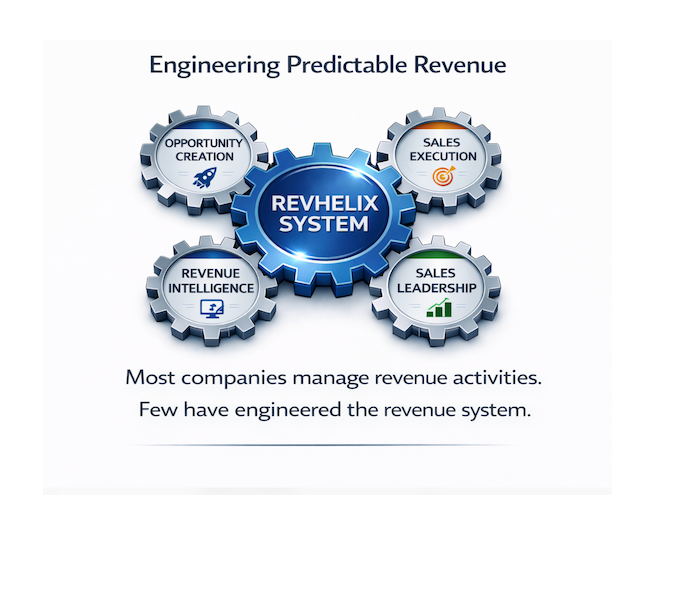
To solve these, the Revenue Architect looks at the RevHelix System to see where the handoffs are failing. If the transition from Opportunity Creation to Sales Execution is not seamless, the deal loses its initial momentum immediately.
Diagnostic: Is Your Sales Cycle Artificially Long?
To determine if you are suffering from velocity erosion, conduct a clinical audit of your last ten closed-lost deals.
- Where was the most time spent? If it was between the “Proposal” and “Closing” stages, your deals are failing at the finish line because of poor early-stage qualification.
- How many “Follow-up” emails were sent per deal? A high number of follow-ups indicates a lack of Up-Front Contracts.
- What was the “Stall Point”? Identify the specific stage where velocity drops. This is your bottleneck.
In many cases, the bottleneck is a lack of Revenue Intelligence. If you don’t have real-time data on how deals are moving through the stages, you can’t see the friction until it has already impacted the quarterly revenue.
Consolidating the System
Fixing velocity erosion is not about “motivating” the sales team. It is about removing the structural defects that cause drag.
- Land: Implement strict qualification criteria. Use Precision Pipeline Generation to ensure only high-intent prospects enter the system.
- Expand: Train the team in Sandler Atlantic principles to maintain control of the timeline. Every interaction must end with a clear, time-bound commitment.
- Consolidate: Review your Revenue Architecture. Ensure that your technology stack: including AI-driven insights: is being used to identify friction points, not just to automate more emails.
A stretched sales cycle is a choice. You can choose to accept the friction as a fact of life, or you can choose to engineer it out of your system. The companies that win are not necessarily the ones with the best product; they are the ones with the most efficient revenue engine.
If your current pipeline feels like a stagnant pond rather than a high-velocity stream, it is time for a Revenue System Assessment. Stop managing activities and start engineering outcomes. Velocity is the only metric that matters in a competitive market. Eliminate the friction, or the friction will eliminate your growth.