
Most B2B sales organizations are built on a foundation of adrenaline and individual willpower. They rely on the “closer,” the “star rep,” or the “hustling founder” to drag deals across the finish line. In the boardrooms of Atlantic Growth Solutions, we identify this as the Superhero Trap.
It is a structural defect. Relying on individual heroics is not a growth strategy; it is a single point of failure. When your revenue depends on the extraordinary effort of a few people, your business is inherently fragile. If the hero burns out, leaves, or simply has an off quarter, the pipeline collapses.
To build a sustainable, scalable enterprise, you must stop looking for superheroes and start investing in Revenue Engineering. Engineering makes growth easy because it shifts the burden of performance from the individual to the system.
The Diagnostic: Identifying the Heroic Failure
The symptoms of the Superhero Trap are clinical and predictable. They manifest as erratic forecasting, high sales team turnover, and a culture that prioritizes “hustle” over process. When we conduct a sales assessment, we often find that what management calls “grit” is actually unacknowledged process debt.
The cost of this defect is staggering. In the SaaS world, for instance, the average tenure of a VP of Sales is now less than 18 months. Why? Because they are often hired as “superheroes” expected to fix broken fundamentals through sheer force of personality. When the lack of Revenue Architecture prevents them from hitting impossible numbers, the system ejects them.
A “hero-based” system has high friction. It requires constant intervention from leadership to keep deals moving. In contrast, a Revenue System treats friction as a mechanical failure. If a deal stalls, it isn’t because the rep didn’t “want it enough”: it’s because the qualification criteria were poorly engineered or the Up-Front Contract was never established.
Phase 1: Land : Establishing Architectural Integrity
In structural engineering, “landing” the foundation is the most critical phase. In revenue terms, this means moving away from “random acts of sales” and toward a Diagnostic Engine.
You cannot fix what you cannot measure. Most companies manage activities (calls, emails, meetings); few manage the revenue system itself. The goal of the Land phase is to install a Revenue Architecture that defines exactly how a lead moves from an anonymous prospect to a closed-won customer.
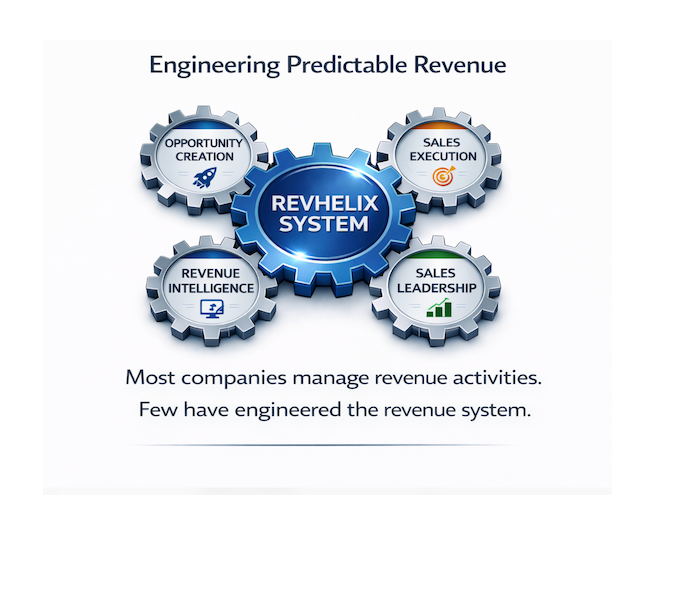
This phase requires:
- Systemic Qualification: Moving beyond basic BANT (Budget, Authority, Need, Timeline) to psychological qualification. We use Sandler Atlantic principles to ensure the prospect has a “pain” that is costing them more than the solution.
- The Up-Front Contract: This is a mechanical control. It eliminates the “mutual mystique” that leads to ghosting. If a meeting doesn’t end with a clear, scheduled next step, the system has failed.
- Revenue Intelligence: Using data to identify where the “leaks” are in your funnel. Is the leak at the top (Precision Pipeline Generation) or the middle (Sales Execution)?
By engineering the foundation, you remove the need for a superhero to save every deal. The system handles the heavy lifting.
Phase 2: Expand : Systemic Throughput and Scale
Once the foundation is set, the objective shifts to expansion. In a hero-based model, scaling means hiring more heroes. This is expensive, risky, and rarely works. In a Revenue Engineering model, scaling means increasing the throughput of the existing machine or replicating the proven blueprint.
This is where B2B Lead Generation Services often fail. They focus on volume over precision. A superhero rep might be able to pick through a mountain of low-quality leads to find a gem, but that is an inefficient use of resources.

Instead, we focus on Precision Pipeline Generation. This involves:
- AI-Enhanced Targeting: Using technology as an execution tool to find the highest-probability targets, but relying on human judgment for the strategic constraint.
- Negative Reverses: A clinical sales technique where the rep periodically “checks out” of the deal to ensure the prospect is actually leaning in. This prevents the “hero” from chasing prospects who have no intention of buying.
- The BAT Triangle: Balancing Behavior, Attitude, and Technique. If any side of the triangle is weak, the structural load of the sales process will cause it to buckle.
When you engineer the “Expand” phase, growth becomes a predictable output of the system. You are no longer hoping for a “big month”; you are monitoring the gauges of your Revenue Operations Consulting dashboard.
Phase 3: Consolidate : Operational Persistence
The final phase of the engineering framework is Consolidation. This is the process of making the revenue system permanent and resistant to external shocks.
Superheroes are temporary. Systems are permanent. To consolidate your gains, you must move the institutional knowledge out of the heads of your top performers and into the RevHelix blueprint.

Consolidation involves:
- Continuous Sales Assessment: Regularly auditing the system to find new friction points. Markets change, competitors adapt, and what worked yesterday may become a bottleneck tomorrow.
- Rigorous Sales Training: Ensuring that every member of the team: not just the “stars”: can execute the Sandler Atlantic methodology with precision.
- Revenue Talent Management: Hiring for system fit rather than “hero potential.” We help clients find RevTalent that thrives within a structured, engineered environment.
By the time a company reaches the Consolidation phase, the “Superhero” is no longer necessary. The sales team operates with a calm, clinical efficiency. Forecasts are accurate because they are based on system data, not rep “gut feelings.” The business is no longer a collection of individuals; it is a high-performance machine.
The Cost of Inaction: The Fragility of the Hero
Choosing to remain in the Superhero Trap is a choice for fragility. Every day your revenue depends on individual heroics is a day your business is at risk.
Revenue Engineering is not an “automatic fix.” It is a discipline. It requires the willingness to dismantle broken processes and replace them with rigorous architecture. It requires moving away from the “hustle” and toward the “engine.”
At Atlantic Growth Solutions, we don’t believe in sales “hacks” or silver bullets. We believe in Revenue Architecture. We treat revenue as a machine that must be designed, built, and maintained.
If your current sales process feels like a struggle: if you are exhausted by the constant need for “heroics”: it is time for a diagnostic. Stop asking your people to be superheroes. Start giving them an engine.
Is your revenue system engineered for growth or built on heroics?
The first step to recovery is a clinical assessment of your current state.
Contact Atlantic Growth Solutions to begin your diagnostic.
Related Resources: