
Most B2B companies are not running a revenue system. They are managing a graveyard of SaaS subscriptions.
Your pipeline is light. Deals are sitting in your CRM, stagnating, and eventually dying. You’ve likely responded to these symptoms by adding more tools: a new sequencing platform, an AI-powered dialer, or a more expensive data provider. You’ve been told that “tech-enablement” is the cure.
It isn’t.
Adding a new tool to a broken process is not an upgrade; it is an expensive distraction. At Atlantic Growth Solutions, we view revenue as a mechanical output. If the machine is failing, adding more grease to a broken gear won’t fix it. You need to stop buying subscriptions and start engineering a Revenue System.
The Diagnostic Failure: Confusing Tools with Architecture
There is a fundamental difference between a tech stack and Revenue Architecture.
A tech stack is a collection of individual point solutions: Salesforce, HubSpot, Outreach, ZoomInfo: purchased to solve isolated problems. The result is often the “Frankenstein Stack”: fragmented data, redundant workflows, and a lack of transparency.
Revenue Architecture, however, is the design and organization of the technology and processes required to support predictable growth. It is the blueprint that dictates how your business generates, captures, and retains value.
When we perform Revenue Operations Consulting, we don’t look at your features; we look at the structural integrity of your revenue engine. Most organizations use less than 50% of their stack’s capabilities. This isn’t a training issue. It is an architectural defect.
The system was never designed to work as a whole. It was assembled piecemeal to satisfy the immediate needs of different departments: marketing wanted leads, sales wanted meetings, and finance wanted reports. Because no one “engineered” the connection between these goals, the system leaks revenue at every handoff.
Precision Pipeline Generation: The “Engineering” Standard
The industry is obsessed with “Lead Gen.” While Lead Gen is a core part of what we do, the term is often misunderstood. It shouldn’t just be about volume; it must be about structural fit within a larger system.
We advocate for Precision Pipeline Generation. This is the “Land” phase of revenue “engineering”.
In a true Revenue System, the “Land” phase is not about casting a wide net. It is about identifying the specific ICP (Ideal Customer Profile) where the commercial tension is highest. Commercial tension exists when a prospect’s current situation is unsustainable, but they lack the internal mechanics to fix it.
Your current “leads” are likely dying because they lack this tension. Your sales team is chasing people who are “interested” but not “compelled.”
We install the RevHelix framework to solve this. It is a tech-enabled human expertise model. We don’t just hand you a list of names; we install the precision mechanics required to create high-intent opportunities. We treat AI and automation as execution tools: the fuel: while human judgment remains the strategic constraint: the engine block.

The Structural Engineering Framework: Land, Expand, Consolidate
To move from a collection of subscriptions to a functional system, you must follow an engineering framework.
1. Land: Precision Targeting
This is the identification of the target market. Most companies fail here because their data is dirty or their targeting is too broad. A functional Revenue System uses precise data to find the exact moment a prospect is experiencing the pain your product solves.
2. Expand: Sales Execution and Mastery
Once a target is identified, the system must engage. This is where Sandler Atlantic principles become the mechanical gears of the system. We don’t rely on “heroic” sales efforts. We rely on the system.
- The BAT Triangle: Behavior, Attitude, and Technique must be aligned within the revenue engine.
- Up-Front Contracts: Every interaction must have a clear, pre-defined outcome. Without this, the system loses momentum.
- Negative Reverses: Instead of “selling,” the system is designed to disqualify prospects who do not fit the structural requirements of your solution.
3. Consolidate: Revenue Intelligence
This is the final phase where the data generated from the Land and Expand phases is fed back into the engine to optimize performance. If you cannot see why a deal died, your architecture is opaque. Consolidate means turning raw activity into actionable intelligence that the CEO can use to make capital allocation decisions.
Why We Don’t “Advise”: We Install
The B2B world is full of consultants who provide 50-page slide decks and then disappear. They offer advice, but they don’t offer “engineering”.
At Atlantic Growth Solutions, we are “engineers”. When you work with us, we aren’t just giving you a “to-do” list. We are installing the RevHelix System.
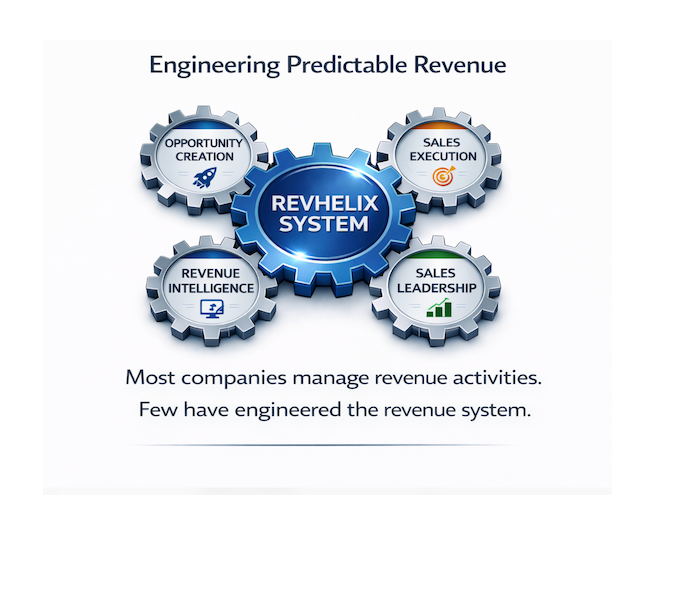
This visual represents the interconnected nature of a true revenue engine. If your Sales Execution gear is spinning but your Opportunity Creation gear is stuck, the system grinds to a halt. Our job is to synchronize these components.
We install the plumbing, the wiring, and the structural supports. We ensure that your CRM isn’t just a database, but a forecasting engine. We ensure your Precision Pipeline Generation isn’t a series of “blasts,” but a targeted campaign that creates actual commercial tension.
Human Judgment: The Strategic Constraint
There is a dangerous myth in the market right now: that AI will replace your sales team and your revenue strategy.
This is a structural misunderstanding of how B2B sales work. AI is an exceptional tool for execution: it can process data, send emails, and transcribe calls at a scale no human can match. However, AI cannot understand nuance, it cannot build an Up-Front Contract, and it cannot navigate the complex emotional landscape of a high-stakes deal.
In our Revenue Operations Consulting, we position AI as a force multiplier for human mastery, not a replacement for it. If you put AI on top of a broken Revenue Architecture, you simply fail faster. The “strategic constraint” of any system is always the quality of the decisions being made.
We use Sandler frameworks to ensure that the humans operating the machine have the technique required to make the right decisions. Tech provides the “how,” but humans provide the “why.”
Identifying the Mechanical Failures
If you are experiencing any of the following, your architecture is failing:
- Low Forecast Accuracy: If your CRO cannot predict revenue within a 5% margin of error, the system is broken.
- High Customer Acquisition Cost (CAC): If you are spending more on tools than you are generating in new pipeline, your subscriptions are cannibalizing your profits.
- The “Hero” Culture: If 20% of your reps are doing 80% of the work, you don’t have a system; you have a collection of lucky outliers.
A true system makes the “average” performer effective because the system provides the momentum. It removes the need for individual “heroics” and replaces it with predictable, repeatable mechanical outputs.
The Path to Revenue Architecture
To fix the machine, you must first stop the bleeding. Stop buying more tools. Stop searching for the “silver bullet” software that promises to automate your way to growth.
Instead, look at your Revenue System as a whole.
- Is your targeting precise?
- Are your sales conversations based on a proven framework like Sandler?
- Is your data providing actual intelligence, or just more noise?
If you are ready to stop managing subscriptions and start installing a system, let’s talk. We don’t provide “advice.” We provide “Revenue Engineering”.
The machine is either working, or it isn’t. If yours isn’t, it’s time to rebuild the architecture from the ground up.