
The failure of a B2B growth initiative is rarely a failure of effort. It is a failure of engineering.
Most executive teams treat sales growth like a plumbing problem: if the pipeline is dry, they buy a bigger faucet. They hire B2B lead generation services to pump more volume into the top of the funnel, expecting the revenue to flow out the bottom. When the revenue fails to materialize, the blame is typically assigned to the external partner.
This diagnosis is usually incorrect. The “faucet”: whether managed by internal teams or reputable firms like Martal Group, The Sales Factory, DMT Business Development, or Purple Sales: is often functional. The failure lies in the pipes. If your internal revenue system is fractured, leaking data, or misaligned with the reality of the buyer’s journey, increasing the volume of “leads” only accelerates the rate of system collapse.
To scale predictably, you must stop searching for “leads” and start practicing Revenue Engineering.
Land: The Structural Flaw in Traditional Lead Generation
The current market for B2B lead generation services is built on an execution-first model. Organizations like Martal Group or Purple Sales excel at high-velocity outreach and top-of-funnel activity. They provide the mechanical energy required to spark conversations.
However, an execution engine is useless if the chassis is warped.
When a company engages an external partner without first performing a Sales Health Assessment, they are essentially grafting a high-performance turbocharger onto a rusted engine. The system cannot handle the pressure. The “leads” generated are viewed as interruptions by a sales team that lacks a unified qualification framework, or they die in a CRM that was never configured to track high-intent signals.
The failure occurs because of a fundamental misunderstanding: Revenue is not an event; it is the output of a mechanical system. If your internal RevOps, data hygiene, and sales execution frameworks are broken, no amount of external “appointment setting” activity will fix your bottom line.
Expand: Why the Revenue System Breaks Under Pressure
To understand why traditional outreach fails, we must look at the specific points of structural failure within the revenue machine.
1. The Data Integrity Gap
Most companies operate on guesswork rather than market intelligence. When you hire firms like The Sales Factory or DMT Business Development, they require a clean Ideal Customer Profile (ICP) and accurate data to be effective.
If your internal data infrastructure is fragmented: where the CRM, marketing automation, and sales activities aren’t synchronized: the external team will inevitably target the wrong accounts. This isn’t an agency failure; it’s a structural defect in your Revenue Intelligence. Without a single source of truth, you are paying for the privilege of spamming the wrong people with the wrong message.
2. The Handoff Friction (The “Black Hole”)
This is the most common point of mechanical failure. An external partner generates a qualified opportunity. They hand it to the internal sales team. Then, the lead disappears.
Why? Because the internal “Revenue System” lacks an Up-Front Contract: a core principle we teach through Sandler sales training. If your account executives don’t have a clear, documented process for receiving and activating opportunities, those leads sit in the CRM and die. The friction between “Inbound/Outbound Activity” and “Sales Execution” is where most ROI goes to vanish.
3. The Volume vs. Velocity Fallacy
Executive leadership often demands volume. They want “100 leads a month.” Firms like Martal Group can deliver that volume. But if your sales cycle is 9 months long and your internal system is only equipped to handle 10 high-touch discovery calls per month, you have created a bottleneck.
Precision Pipeline Generation focuses on velocity and conversion quality, not raw numbers. If you cannot process the volume, the volume becomes a liability, not an asset.

Consolidate: Transitioning to Revenue Engineering
If you are seeing a disconnect between “activity” and “closed-won revenue,” you do not need more leads. You need a surgical intervention in your revenue system.
At Atlantic Growth Solutions, we do not view lead generation as a standalone marketing service. We view it as one component of a broader engineering project. Before we turn on the outreach engine, we must ensure the system can support the load.
Step 1: The Sales Health Assessment
You cannot fix what you have not diagnosed. A Sales Health Assessment identifies the specific constraints in your current model. Are you failing at the Land (targeting), the Expand (qualification), or the Consolidate (closing) phase?
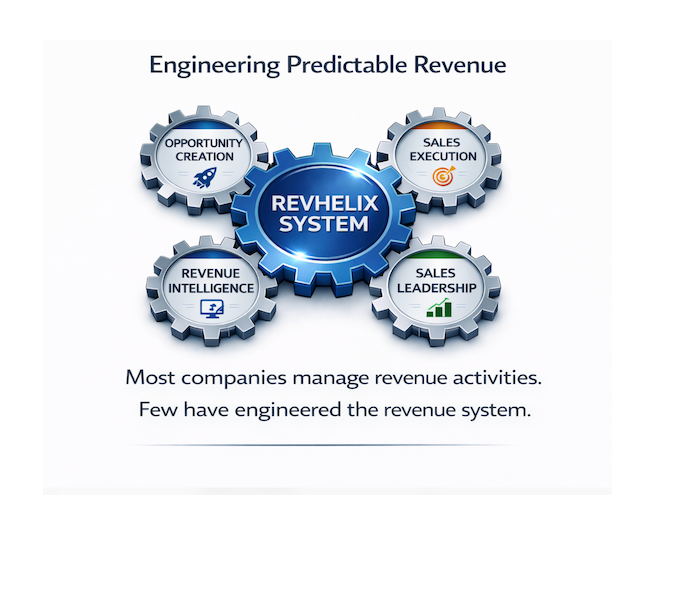
We look at your system scores across five pillars:
- Opportunity Creation: Are your outreach sequences engineered for resonance or just noise?
- Sales Execution: Does your team use a consistent methodology like Sandler to qualify intent?
- Revenue Intelligence: Is your CRM a tool for growth or a graveyard for data?
- Sales Leadership: Is there a cadence of accountability, or are you relying on “heroics”?
- Strategy: Is your GTM plan based on cold, hard data?
Step 2: Precision Pipeline Generation
Once the system is stabilized, we implement Precision Pipeline Generation. Unlike traditional B2B lead generation, this process is integrated directly into your revenue system.
We don’t just “pass leads.” We engineer the conversations using the BAT Triangle (Behavior, Attitude, Technique). By ensuring that every outreach effort is technically sound and strategically aligned with your ICP, we eliminate the “junk volume” that clogs your pipeline.

Step 3: Removing the “Hero” Constraint
Many B2B companies rely on a “Hero Salesperson”: the one individual who can close deals despite a broken system. This is a massive structural risk. Revenue Engineering replaces individual heroics with a repeatable, mechanical process.
By utilizing Sandler (for Sales training), we ensure that the entire team follows a diagnostic, clinical approach to selling. This makes the revenue output predictable, regardless of who is operating the system.
The Cost of Structural Neglect
Continuing to pour money into B2B lead generation services without fixing the underlying revenue system is a form of financial negligence.
Firms like Purple Sales or DMT Business Development can provide the fuel. But if your engine has a cracked block, you are simply wasting fuel and risking a total system blowout. The friction in your sales process: the missed follow-ups, the misaligned messaging, the lack of data visibility: costs more than any agency fee.
It manifests as:
- High Customer Acquisition Cost (CAC): Because you are paying for leads that never convert.
- Stagnant Pipeline Velocity: Because opportunities are stuck in “qualified” stages forever.
- Inaccurate Forecasting: Because leadership has no real visibility into what is a “deal” versus an “activity.”

Conclusion: Stop Buying Leads, Start Building Systems
The B2B landscape in Canada and beyond is too competitive for “good enough” sales processes. If your forecasts keep missing and your pipeline feels light despite constant outreach, the problem isn’t the leads. The problem is the machine.
Atlantic Growth Solutions doesn’t offer a “magic pill” for growth. We offer a surgical, engineered approach to building a revenue system that works. We don’t just find you people to talk to; we ensure that your internal infrastructure is capable of turning those conversations into revenue.
Is your revenue system engineered for growth, or is it just holding together by habit? Stop guessing. Run a Sales Health Assessment and find the cracks before they become craters.