
The pipeline is a lie.
When a deal stalls at the signature line, the sales organization treats it as an anomaly, a sudden change in the weather. They blame the “economic climate,” a “shifting internal priority,” or a “silent stakeholder.” These are excuses, not diagnoses. In a high-performance Revenue Architecture, there is no such thing as a deal that “slips.” There are only deals that were never qualified to begin with.
A late-stage stall is not a closing problem. It is an engineering failure. It is the result of structural rot that began in the first fifteen minutes of the first discovery call. If your revenue machine depends on late-quarter heroics and “closing techniques” to drag deals across the finish line, you do not have a sales process. You have a gambling habit.
The Autopsy: Identifying Structural Rot
To fix a failing revenue system, you must first perform an autopsy on the deals that died. We look past the symptoms and examine the skeletal structure of the opportunity. In almost every instance of a late-stage stall, the failure can be traced back to one of three qualification defects.
1. The False Positive: Pain Without Budget
Salespeople are often seduced by “Pain.” They find a prospect who is frustrated, vocal, and eager to talk. They mistake this emotional resonance for a business opportunity. However, pain without a clear fiscal impact is merely a complaint. If the prospect cannot quantify the cost of inaction, the CFO will eventually kill the deal. This is why many forecasts are wrong, they are built on empathy rather than economics.
2. The Invisible Committee: Decision Process Failure
The deal looks strong because the “champion” is enthusiastic. But in B2B Sales Services, the person you are talking to is rarely the person who can say “yes.” They are, however, the person who can say “no” or, worse, say nothing at all while the deal rots. If you have not mapped the decision-making unit and understood the internal politics of the capital allocation process, you are flying blind.
3. The Lack of an Up-Front Contract
This is a core Sandler Atlantic principle. If there is no clear agreement on what happens at the end of every interaction, the prospect defaults to “thinking about it.” A deal that stalls at the end usually lacked an Up-Front Contract at the beginning. You cannot engineer a predictable outcome without a mutually agreed-upon roadmap.
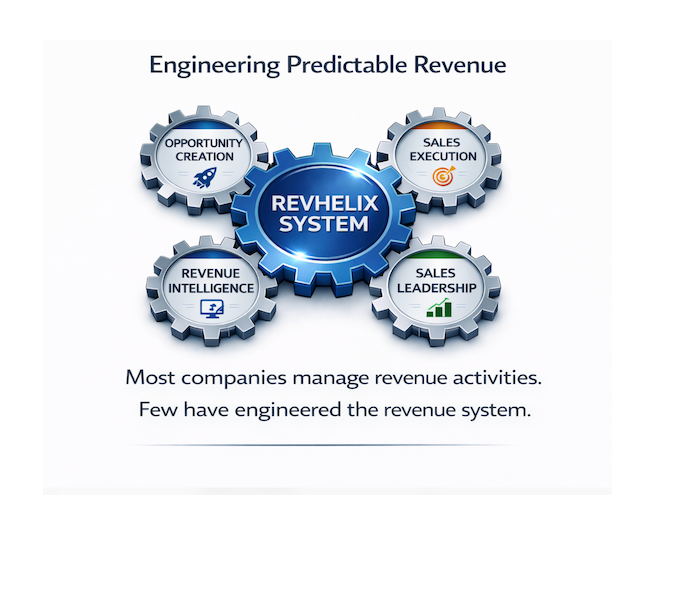
Land: Establishing the Foundation
In structural engineering, the foundation must support the weight of the entire build. In Revenue Architecture, the foundation is Precision Pipeline Generation.
Most companies approach pipeline generation as a volume game. They flood the top of the funnel with low-intent leads and expect the sales team to “filter” them. This is a waste of resources. High-velocity revenue systems require a clinical approach to lead identification. At Atlantic Growth Solutions, we treat B2B Lead Generation Services as a diagnostic exercise. We are not looking for anyone who will talk to us; we are looking for organizations where our solution solves a critical structural constraint.
When the foundation is weak, the “load” of the closing process causes the deal to collapse. This is why why-pipeline-doesnt-equal-revenue. A bloated pipeline is often just a collection of late-stage autopsies waiting to happen. To prevent this, every lead entering the system must be subjected to a rigorous Revenue System Assessment.

Expand: The Discipline of Sales Execution
Once the foundation is set, the structure must be built with precision. This is where most organizations revert to “heroics.” They hire “rockstar” closers and hope their personality can overcome a flawed system. This is a catastrophic error in Sales Recruitment.
Revenue is a machine, not a miracle. The middle of the sales cycle, the expansion phase, requires surgical execution. This is where Sales Training based on Sandler principles becomes the differentiator.
The Revenue Architect does not “pitch.” They diagnose. They use Negative Reverses to test the prospect’s commitment. They ask the uncomfortable questions about budget and decision-making long before the proposal is drafted. If the deal is going to die, the Revenue Architect wants it to die in the discovery phase, not the closing phase.
Closing heroics are expensive, unpredictable, and unscalable. Engineering discipline, on the other hand, provides Revenue Operations with the data needed to create accurate forecasts. When a deal is built correctly, the “close” is merely the logical conclusion of a well-engineered process.
Consolidate: Removing Friction from the System
The final stage of the architecture is consolidation, ensuring the deal crosses the finish line without friction. If a deal stalls here, it is often because the Revenue Constraint was never identified.
Friction occurs when the sales process is out of alignment with the buyer’s journey. Most sales teams are so focused on their own internal milestones, Discovery, Demo, Proposal, that they ignore the buyer’s internal hurdles. To consolidate a deal effectively, you must understand the prospect’s procurement, legal, and IT security requirements before they become “surprises” in week 12 of the quarter.
This level of deal control requires a shift in mindset. You are not a vendor hoping for a signature. You are a consultant managing a transition. This is the hallmark of Mastering Solution Sales.

The Mirage of the “Late Stage”
Why do we call it an autopsy? Because by the time a deal “stalls,” it is usually already dead. It just hasn’t stopped moving yet. The “late-stage” designation in your CRM is often a mirage.
If you look at your CRM and see a high volume of deals in the “90% probability” stage that have been sitting there for three weeks, you don’t have a closing problem. You have a qualification defect. You are looking at a graveyard, not a pipeline.
The cost of these “zombie deals” is immense:
- Opportunity Cost: Your best sales talent is wasting time “following up” on dead deals instead of pursuing fresh Precision Pipeline Generation.
- Distorted Data: Your Revenue Operations team is providing the CEO with forecasts that are mathematically impossible.
- Moral Decay: The sales team becomes addicted to the “hope” of the big close rather than the “discipline” of the daily process.

Engineering the Solution
Stopping the cycle of late-stage stalls requires a brutal reappraisal of your sales culture. You must move from a culture of “Closing Heroics” to a culture of “Revenue Engineering.”
- Audit the Pipeline: Perform a clinical autopsy on every deal that has sat in the late stages for more than 1.5x your average sales cycle. If the pain isn’t quantified and the decision-maker isn’t identified, move it back to discovery or kill it.
- Reinforce the Foundation: Invest in Precision Pipeline Generation that prioritizes qualification over quantity.
- Implement Up-Front Contracts: Make it a non-negotiable part of your Sales Training. No meeting happens without a clear, agreed-upon next step and a “yes/no” outcome.
- Fix the Talent Gap: Stop hiring “closers” and start hiring “engineers.” Use specialized Sales Recruitment to find professionals who value process over personality.
Revenue is not something that happens to you. It is something you build. If your deals are dying at the finish line, stop looking at the finish line. Look at the foundation.
If you are ready to stop guessing why your deals are stalling and start engineering a predictable revenue stream, it is time for a Revenue System Assessment. The autopsy is over. It’s time to build something that lives.